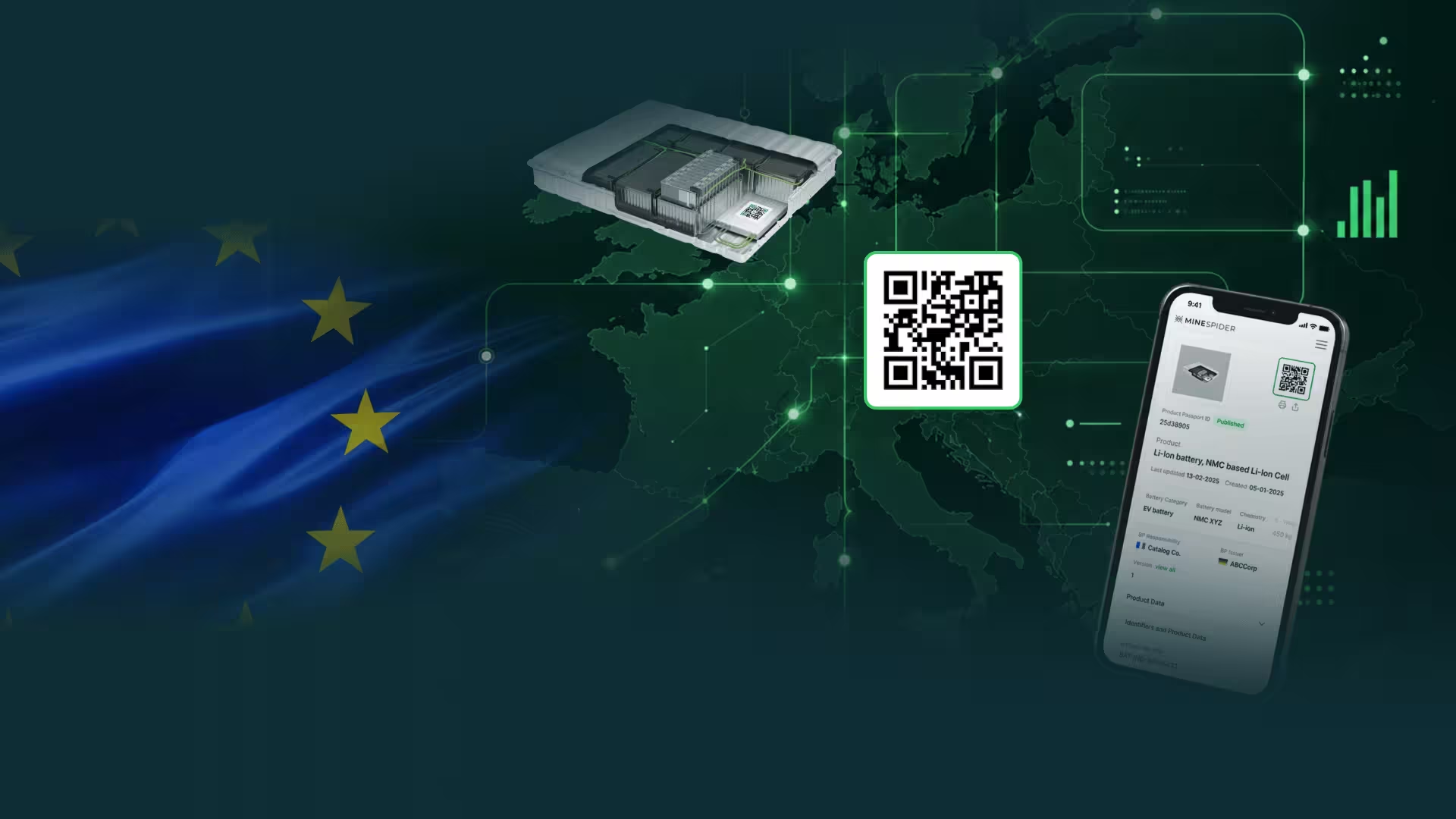
In industrial Battery Passport projects, the conversation often starts with the regulation: which data is required, which batteries are in scope, what identifier should be used, and where should the QR code go? Those are important questions, but once implementation starts, another question usually becomes harder to answer: where does all of that data actually come from?
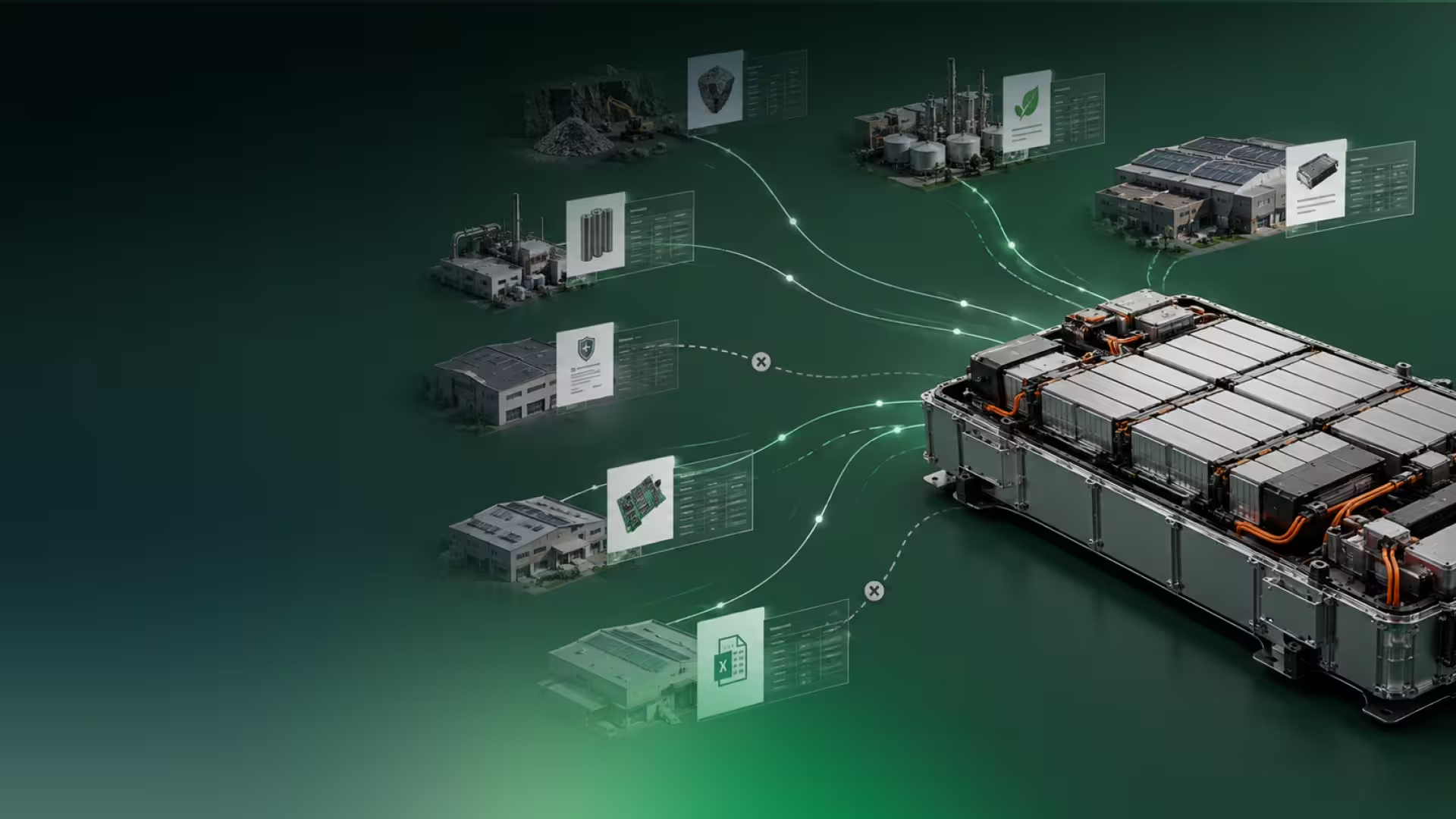
An industrial battery manufacturer may have detailed information about its own production process, product architecture, and internal systems. But the battery itself is built from a wider supplier network. Cell specifications, BMS components, material information, certificates, test reports, and sustainability documentation may all come from different sources. By the time this information needs to come together in a Battery Passport, the manufacturer is often working with data it does not fully control.
Contrary to what many companies believe, supplier data frequently becomes the single biggest bottleneck in implementation. The issue is not always that suppliers lack the required information - in many cases, they already have it. We often see that the difficulty lies in how information is stored across different systems, provided at varying levels, delivered in incompatible formats, or accompanied by inconsistent evidence.
We see that before a manufacturer can create a Battery Passport, they often have to understand who owns each data point, what it describes, how it connects to the battery, and what happens when it changes.
Battery Passport reaches beyond the manufacturer
Under the EU Battery Regulation, Battery Passports will be required from 18 February 2027 for industrial batteries with a capacity above 2 kWh placed on the EU market or put into service. The information associated with the Battery Passport can cover battery characteristics, performance and durability, materials and composition, sustainability-related information, due diligence, and lifecycle information, depending on the applicable requirements and implementation timeline.
For an industrial battery manufacturer, these data points rarely sit in one place. A manufacturer may know the final battery’s model, serial number, and production location, while information about a cell, component, material, or manufacturing input remains with a supplier. Carbon footprint information, technical documentation, and test evidence may also come from external testing organisations.
Supplier-dependent data may include:
- Cell, module, and component specifications
- Material and composition information
- Safety documentation and test reports
- Declarations of conformity and certificates
- Carbon footprint or recycled-content information
- Due diligence data related to lithium, nickel, cobalt, and natural graphite
- Repair, replacement, or lifecycle information from service partners
Not every supplier will provide every type of information, and not every data point will apply to every industrial battery. What we believe matters most is identifying early which Battery Passport attributes depend on external data and who ultimately owns it.
Industrial batteries make supplier data particularly complex
The issue becomes more pronounced with industrial batteries because the product itself can have a much more complicated architecture than a conventional battery pack. A stationary energy-storage system may combine cells, modules, packs, racks, BMS hardware and software, cooling equipment, power electronics, and safety systems; each with their own technical information, identifiers, and production histories.
That structure can also change over time. A pack can be replaced, a module repaired, a component upgraded, or a battery system moved to a second-life application. When we work with manufacturers, we emphasize that supplier data cannot be collected once during production and then simply forgotten. If a supplier updates a specification, replaces a component, or issues a new batch, the Passport data must update alongside it. Ultimately, the data needs to remain connected to the physical product throughout its lifecycle.
Having the data is not the same as having usable Battery Passport data
One of the easiest traps is to equate supplier data collection with simple document collection. A manufacturer can request certificates, declarations, datasheets, test reports, and spreadsheets from suppliers and still have significant work left before that information can be used.
A certificate may contain relevant info, but you still need to know which component or battery model it applies to and whether it covers a batch or an entire product family. A spreadsheet might contain the right value but use different terminology, units, or identifiers. In other words, the issue is rarely missing information, it's essentially disconnected information.
This matters because Battery Passports require an interoperable, machine-readable, structured, and searchable format. Supplier documents are useful evidence, but they don’t automatically provide the structured relationships needed to populate and maintain a Passport.
Reusability, confidentiality, and lifecycle updates
Supplier information doesn’t always have one fixed relationship with the finished battery. Some component data can be reused across several products, while other information must remain specific to a single production batch. A well-structured supplier data model helps manufacturers distinguish between reusable global data and instance-specific data.
Suppliers may also hesitate to expose proprietary technical specifications to every public viewer. Access rules and public/private data layers are essential so that manufacturers, customers, recyclers, and authorities only see the data relevant to their role.
The biggest mistake we see is treating supplier data as a one-time project. Industrial batteries don’t stop changing when they leave the factory. A supplier data workflow must answer a question that a static spreadsheet can’t: what happens when something changes?
What manufacturers should do before 2027
Don’t worry, the first step doesn’t need to be a massive, enterprise-wide integration project. We often advise taking one representative battery model, mapping the information required for its Battery Passport, and working backwards to identify internal data versus external supplier dependencies.
This exercise quickly highlights where the real gaps sit. The manufacturer can then determine what suppliers need to provide, whether data applies at the model or batch level, and how updates should be communicated.
Testing this on a limited scale allows manufacturers to establish a repeatable process before rolling it out across full product portfolios. The goal isn’t to make every supplier fully Battery Passport-ready overnight; it’s to eliminate surprises before production begins.
Scaling beyond the first Battery Passport
It’s possible to make almost any data-collection process work for one battery model if enough people manage it manually. But that approach fails when you scale to multiple battery lines, dozens of suppliers, and thousands of components. This is where the difference between a pilot and a production workflow becomes clear. The supplier process needs to be repeatable, connected to the right records, and manageable without starting again.
Where Minespider fits
At Minespider, we approach supplier data as a fundamental part of the Battery Passport architecture rather than simply an exercise in chasing documents. The platform helps manufacturers structure supplier information, map it to relevant Passport attributes, connect supporting documents to the right records, and manage access controls through structured imports or API integrations.
Battery Passport may ultimately be published by the company placing the battery on the market, but the information behind it starts much further upstream. The QR code is only the visible surface; the real work lies in managing the supply chain behind the data.
Start building your Battery Passport strategy before supplier data becomes a bottleneck. Book a discovery call to see how Minespider can help you structure, connect, and manage the data behind your passports.
Book a Discovery Call