The Digital Battery Passport Implementation Report 2026:
Industry Perspectives on EU Compliance
This report provides an overview of the latest developments shaping the global battery ecosystem, including regulatory trends, Digital Battery Passport requirements, supply chain responsibilities, implementation challenges and future industry directions.


Battery Value Chain and Data Responsibilities
Digital Battery Passports are often associated with battery manufacturers and companies placing batteries on the market. In reality, however, the information required to create and maintain a Digital Battery Passport originates from multiple participants across the battery value chain.
Data related to raw material sourcing, processing, manufacturing, transportation, battery assembly, performance, carbon footprint, recycled content, and end-of-life management is generated at different stages of a battery's lifecycle. As a result, Digital Battery Passports rely on collaboration and data exchange between a wide range of stakeholders rather than a single organization.
As Digital Battery Passports become more widely adopted, organizations throughout the battery ecosystem are expected to play a role in collecting, sharing, verifying and maintaining battery-related data. The following sections explore the key participants within the battery value chain and the information they contribute throughout a battery's lifecycle.


1. Raw and processed materials providers
Raw material producers and processors form the foundation of the battery value chain. As transparency, traceability, and responsible sourcing requirements continue to expand globally, these organizations play a critical role in providing the data required throughout the battery lifecycle.
Key information typically includes material origin, supply chain traceability, production locations, quantities supplied, carbon footprint data, and sustainability-related documentation. Increasingly, downstream manufacturers require this information to support regulatory compliance, sustainability reporting, carbon footprint calculations, and Digital Battery Passport requirements.
In this context, Digital Battery Passports do not replace existing due diligence or sustainability frameworks. Instead, they serve as a mechanism for collecting, managing, and sharing verified information across the value chain. This enables manufacturers, regulators, and other stakeholders to access consistent data related to material provenance, environmental impacts, and responsible sourcing practices.
As a result, raw material suppliers are becoming increasingly important contributors to the digital data ecosystem supporting battery traceability and compliance.
2. Precursors and battery active materials
Manufacturers of precursors, cathode active materials and anode active materials occupy a critical position within the battery value chain. At this stage, raw materials undergo significant transformation into the components that ultimately determine battery performance, safety, and sustainability characteristics.
As regulatory and industry expectations around transparency continue to increase, companies operating at this level are expected to maintain reliable records related to material provenance, sourcing practices, production processes, and associated environmental impacts. Data generated at this stage often forms a significant portion of the information later used for carbon footprint calculations, traceability requirements, sustainability reporting and Digital Battery Passports.
In addition, producers of battery materials play an important role in tracking recycled content and supporting circularity objectives. As recycled materials become increasingly integrated into battery production, companies are expected to provide verifiable information regarding the origin, composition and share of recycled materials used within their products.
3. Battery cell, module & pack manufacturer
Battery manufacturers occupy a central position within the Battery Passport ecosystem. At this stage, information generated across multiple tiers of the supply chain is consolidated and connected to a specific battery product, battery model or individual battery.
In addition to manufacturing and product-related information, battery producers are increasingly expected to collect, manage and validate data originating from upstream suppliers. This may include information related to material provenance, carbon footprint, recycled content, responsible sourcing practices and other sustainability data required by regulations.
Battery manufacturers are also responsible for maintaining key battery-specific information, including technical specifications, battery chemistry, performance and durability characteristics, conformity assessments, unique battery identifiers and other lifecycle-related data.
As Digital Battery Passport requirements continue to evolve, the role of battery manufacturers extends beyond physical production. They are becoming the primary coordinators of battery data, connecting information from raw material suppliers, material processors, component manufacturers, OEMs, and downstream stakeholders into a unified digital record.
For many organizations, the challenge is no longer generating data, but ensuring that information remains accurate, traceable, verifiable, and accessible across increasingly complex global supply chains. This is one of the key drivers behind the growing adoption of Digital Battery Passport solutions and digital traceability systems throughout the battery industry.
4. Original Equipment Manufacturers (OEMs)
Once a battery is integrated into an electric vehicle or other end product, Original Equipment Manufacturers (OEMs) become important contributors to the battery lifecycle data ecosystem. Throughout the operational life of the battery, manufacturers may collect and manage information related to battery usage, performance, maintenance and State of Health (SoH).
This information can provide valuable insights into battery degradation, remaining useful life, warranty management, and overall asset performance. As batteries remain in service for many years, lifecycle data becomes increasingly important for evaluating repair, refurbishment, repurposing, and second-life opportunities.
Digital Battery Passports can help OEMs maintain a trusted record of battery history, enabling greater transparency for vehicle owners, fleet operators, service providers, secondary markets, and recycling organizations. In addition, access to reliable lifecycle data can support more informed decisions throughout the battery's operational and end-of-life stages.
As the industry moves toward more circular business models, OEMs are expected to play a growing role in ensuring that battery data remains accessible, accurate, and transferable across multiple ownership and usage cycles.
5. End-of-Life Management and Circularity
he value of battery data becomes particularly evident at the end-of-life stage. The more complete, accurate and accessible the information associated with a battery is, the more effectively stakeholders can determine the most appropriate next step in its lifecycle.
Digital Battery Passports should provide access to information such as battery chemistry, material composition, manufacturing history, State of Health (SoH), performance characteristics, repair and dismantling guidance and other lifecycle-related data. This information can support informed decision-making regarding reuse, refurbishment, repurposing, second-life applications, and recycling.
For recyclers and other end-of-life operators, access to reliable battery information can improve operational efficiency, resource recovery rates, and safety during handling, transportation, dismantling and processing. It can also help identify opportunities to recover valuable materials and reintroduce them into future battery production.
As the battery industry increasingly embraces circular economy principles, Digital Battery Passports are becoming an important enabler of battery circularity by helping stakeholders maximize the value retained within batteries and their materials throughout multiple lifecycle stages.
How does the battery passport fit within the circular economy aspect?
The transition toward a circular battery economy depends on the ability to track materials, components and products throughout their lifecycle and gain relevant information about their state. Stakeholders require access to reliable data about battery origin, composition, performance and environmental impact.
Digital Battery Passports help create a shared digital record that can accompany a battery throughout its lifecycle. This information includes material provenance, carbon footprint data, recycled content, battery chemistry, State of Health (SoH), performance characteristics and end-of-life handling guidance. Access to such data enables organizations to identify opportunities for reuse, refurbishment, remanufacturing, repurposing and recycling, helping to maximize resource efficiency and extend the useful life of battery materials.
Digital Battery Passports are emerging as one of the key mechanisms enabling the flow of trusted battery data required to support traceability, compliance, and circularity objectives throughout the battery ecosystem.

Global Regulatory Landscape
Although regulatory approaches differ significantly across regions, a common global trend is emerging: battery supply chains are becoming increasingly transparent, traceable and data-driven. Governments are introducing new frameworks to secure critical materials, strengthen domestic manufacturing capabilities, improve sustainability performance and increase visibility across the battery lifecycle.
The European Union has taken the most comprehensive regulatory approach through the EU Battery Regulation and Digital Battery Passport requirements, while the United States focuses on industrial policy, domestic manufacturing and supply chain security through initiatives such as the Inflation Reduction Act. Canada is positioning itself as a strategic supplier of critical minerals, China continues to expand battery traceability and lifecycle management systems at scale, Japan is strengthening resource circularity and recycling capabilities, and South Korea is advancing battery tracking, safety certification, and second-life battery management. In this Chapter, we will have a glance at some major regulatory developments in the EU, US, Canada, Japan, China and South Korea.
🇪🇺 Europe
The European Union has progressively developed a comprehensive regulatory framework for critical raw materials and batteries as part of its broader climate and industrial policy agenda. To achieve carbon neutrality by 2050, among other steps under the EU Green Deal’s top priorities, the European Commission has introduced the new Circular Economy Action Plan that aims to ensure that used resources are kept in the EU economy. The Circular Economy Action Plan focuses on the most resource-consuming sectors where the potential for circularity is high with batteries and EV production being among those.
Under the Circular Economy Action Plan, the Commission proposed a new regulatory framework for batteries, which replaced the previous Batteries Directive with a directly applicable Regulation across all EU Member States. In particular, it:
- Sets the common rules for the battery segment across the EU,
- Introduces mandatory recycled content requirements,
- Sets the requirements for sustainability and transparency of battery production and recycling, including the carbon footprint of battery manufacturing, ethical sourcing of raw materials and security of supply, and facilitating reuse, repurposing, and recycling.
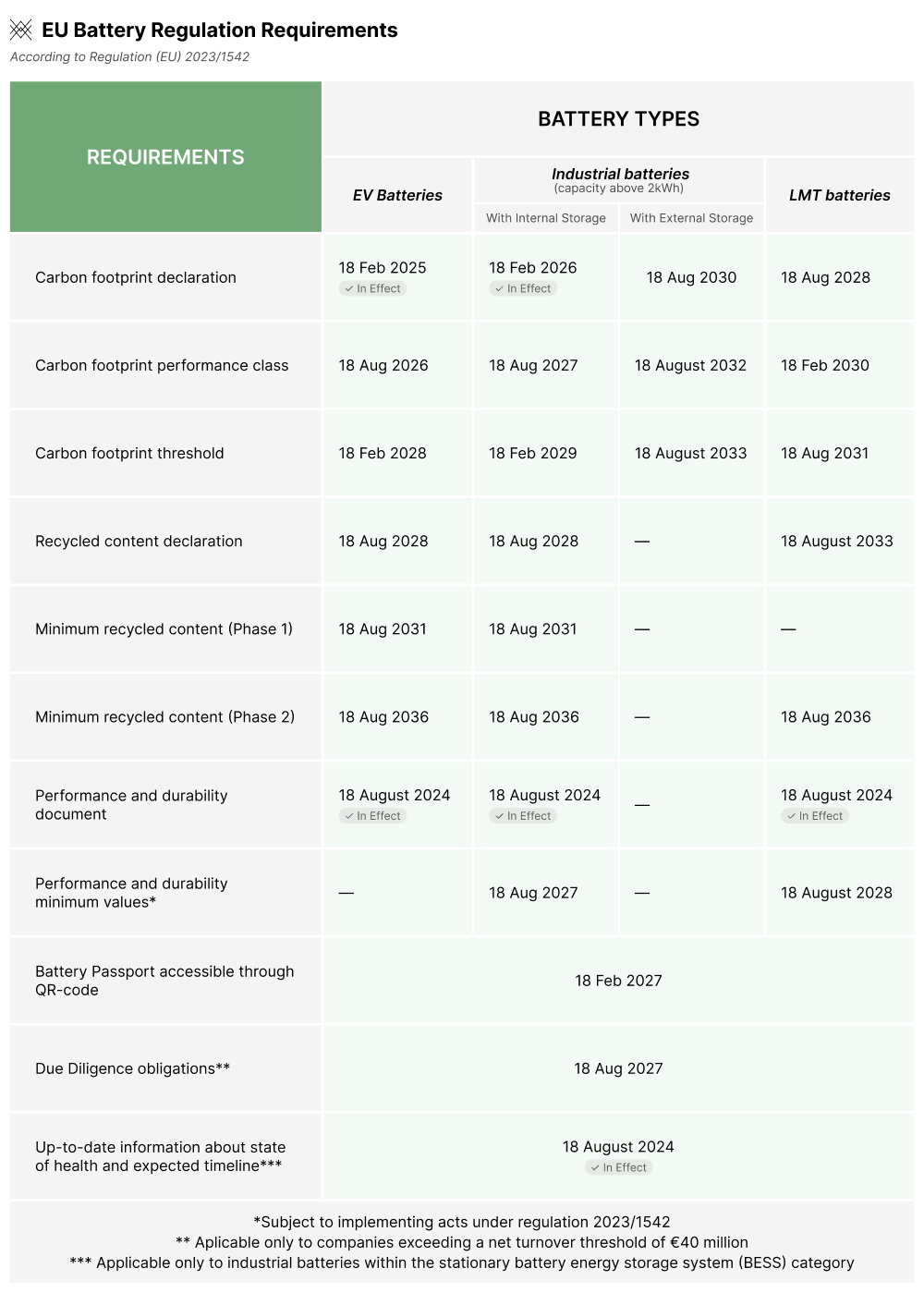
Following political agreement between the European Commission, the European Parliament, and the Council in late 2022, the new framework was formally adopted in 2023 as Regulation (EU) 2023/1542. The Regulation entered into force in August 2023 and is being implemented progressively, with different obligations applying according to defined timelines.
The Digital Product Passport Registry: The EU's Central Infrastructure
While much of the discussion around the EU Battery Regulation focuses on the Battery Passport itself, an equally important development is the infrastructure being built to support it. Under Article 13 of the Ecodesign for Sustainable Products Regulation (Regulation (EU) 2024/1781, the ESPR), the European Commission is required to establish a central Digital Product Passport Registry, with the obligation to have it operational by the 19th July 2026.
It is worth being precise about what this registry is and is not. The registry is not the battery passport, and it does not store the full lifecycle dataset of every product. Instead, it functions as a central index. At a minimum, it holds the unique product identifiers and the data carriers, such as QR codes, that link a physical product to its passport. In practice, it acts as the connective layer that allows regulators, customs authorities, and other authorized parties to locate and verify passports across the single market, regardless of which platform or system holds the underlying data.
This distinction matters for understanding how the European framework fits together. The ESPR is the overarching regulation that introduces the Digital Product Passport concept across nearly all physical goods sold in the EU, and the central registry is established under it. The Battery Passport, by contrast, is created under the Battery Regulation (Regulation (EU) 2023/1542) and is a sector-specific instrument. The two are distinct regulations, but they are designed to interlock: the Battery Passport is widely regarded as the first mandatory implementation of the broader DPP approach, and it is expected to connect into the central registry established under the ESPR.
The sequencing of deadlines makes this relationship concrete. The central registry must be operational by the 19th July 2026, several months before the Battery Passport becomes mandatory on the 18th February 2027. For organizations across the battery value chain, this means the infrastructure into which battery data must ultimately flow is being finalized first, with the passport obligation following. As additional product categories such as textiles, electronics, and construction products come under DPP requirements through their own delegated acts, they are expected to register through the same central infrastructure, gradually making the registry a shared backbone for product transparency across the European economy.
For battery industry stakeholders, the practical implication is that 2026 should be treated as a year of infrastructure readiness. The work of collecting lifecycle data, establishing QR and data carrier workflows, integrating supplier data, and preparing for registration cannot wait until the 2027 deadline. The systems that will read, verify, and index battery data are being switched on now.
🇺🇸 The United States
The United States has significantly expanded its support for the domestic battery and electric vehicle industries in recent years. Through legislation such as the Bipartisan Infrastructure Law, the CHIPS and Science Act, and the Inflation Reduction Act (IRA), the country has introduced large-scale incentives aimed at strengthening domestic manufacturing, securing critical mineral supply chains, and reducing dependence on foreign battery production.
Among these initiatives, the Inflation Reduction Act (IRA) has become one of the most influential policy instruments shaping the North American battery ecosystem. Unlike the European Union, which focuses heavily on sustainability, circularity and digital battery information requirements, the US approach is primarily driven by industrial policy, supply chain resilience, and domestic manufacturing incentives.
The IRA introduced a series of tax credits and financial incentives tied to battery manufacturing, electric vehicle production, critical mineral sourcing, and battery component assembly. Eligibility for many of these incentives depends on where battery materials are extracted, processed, recycled, and manufactured, creating strong incentives for companies to increase visibility into their supply chains.
In recent years, additional guidance related to Foreign Entity of Concern (FEOC) restrictions has further increased the importance of battery traceability. To remain eligible for certain incentives, manufacturers must demonstrate that critical battery materials and components do not originate from restricted entities. As a result, battery and automotive companies are increasingly required to document material origin, processing pathways, supplier relationships, and sourcing practices throughout the value chain.
The legislation has also accelerated investment in mining, refining, precursor production, battery manufacturing, and recycling facilities across the United States and allied trade partner countries. This trend has reinforced the growing importance of regionalized supply chains and "friend-shoring" strategies, where critical battery materials and components are sourced from trusted partner countries.
While the US regulatory approach differs significantly from the European Union's Battery Regulation, both frameworks are contributing to a broader global trend toward greater supply chain transparency, traceability, and accountability. In practice, both systems increasingly require companies to understand where materials originate, how they are processed, and how information is exchanged across the battery value chain.
As battery regulations continue to evolve globally, the ability to collect, verify, and share trusted supply chain data is becoming a strategic capability rather than simply a compliance exercise.
🇨🇦 Canada
Canada has positioned itself as a strategic player within the North American battery ecosystem, focusing on critical minerals, battery manufacturing, and supply chain development. Rather than emphasizing battery-specific traceability requirements, Canada's policy approach has largely centered on securing its role as a reliable supplier of the raw materials and industrial capabilities required for the global energy transition.
Building on its Critical Minerals Strategy, Canada has prioritized the development of domestic supply chains for key battery materials, including lithium, graphite, nickel, cobalt, copper, and rare earth elements. The country has introduced a range of incentives designed to accelerate mineral exploration, processing, refining, battery manufacturing, and recycling activities.
Canada's approach is closely aligned with broader North American industrial policy initiatives, particularly those introduced under the United States Inflation Reduction Act (IRA). As a result, Canada is increasingly viewed as an important partner in regional "friend-shoring" strategies aimed at creating resilient battery supply chains and reducing dependence on concentrated global sources of critical materials.
The growing importance of battery supply chain transparency is also increasing expectations around traceability, responsible sourcing, and environmental performance. As manufacturers seek to demonstrate compliance with regulatory requirements across multiple jurisdictions, reliable data on material origin, processing, and sustainability performance is becoming increasingly important throughout the Canadian battery value chain.
While Canada has not introduced a battery-specific regulatory framework comparable to the EU Battery Regulation, its policies continue to support the development of a more transparent, resilient, and sustainable battery ecosystem across North America.
🇨🇳 China
China remains the world's most influential battery market and manufacturing hub, playing a dominant role across critical mineral processing, battery materials production, cell manufacturing, and battery recycling. Historically, its regulatory approach emphasized industrial development, supply chain control, resource security, and large-scale deployment rather than the sustainability reporting and passport requirements seen in Europe. That picture is now changing quickly.
China was among the first major markets to introduce national battery traceability systems for electric vehicle batteries, and it has continued to expand them. The most significant recent development is the Provisional Regulation for the Recovery and Comprehensive Utilization of Electric Vehicle Batteries, issued at the end of December 2025 by six ministries and entering into force on 1 April 2026. This regulation establishes a mandatory digital battery identity document, often described as a "digital ID," for each battery unit. The identity record tracks a battery through production, sale, maintenance, replacement, scrapping, and recycling, making each unit traceable and verifiable throughout its life. The supporting national traceability platform is coordinated by the Ministry of Industry and Information Technology, with the China Automotive Technology and Research Centre providing technical support and operating it, and authorities intend to use it for real-time supervision, risk monitoring, and coordinated data management.
The scale behind this regulation explains its urgency. EV production and sales in China each exceeded 16 million units in 2025, accounting for more than half of domestic new vehicle sales, and the country is now entering a period of large-scale battery retirement, with used battery volumes projected to exceed one million tonnes by 2030. A central objective of the new framework is to bring order to end-of-life handling, preventing retired batteries from entering informal or unregulated channels and curbing practices such as illegal dismantling and the reselling of used cells as new.
China's approach shares clear objectives with the EU model, including improved traceability, lifecycle visibility, and material recovery, and the regulation contemplates data on carbon footprint, recycled content, and ESG criteria. However, the emphasis differs. Where the EU Battery Passport requires traceability all the way back to raw material extraction, the Chinese system prioritizes control over the lifecycle of the already-manufactured product, with particular focus on recycling and the second-life market. In parallel, China is introducing battery carbon footprint reporting requirements covering material sourcing, manufacturing, distribution, and recycling.
There are also early signs of convergence at the standards level. Minespider, working with the Chinese national high-tech enterprise Shenzhen Precise Testing Technology Co., Ltd. (PTL), has been collaborating on the development of Digital Battery Passports and battery passport guidance for the Chinese market, an example of how European traceability expertise and Chinese industry capabilities are beginning to align around shared data and passport frameworks. Although China's regulatory architecture differs significantly from those emerging in Europe and North America, the direction of travel, toward greater traceability, lifecycle data management, and circularity, is increasingly shared.
🇯🇵 Japan
Japan has long been a pioneer in resource efficiency, recycling, and circular economy policies. In recent years, however, the country's approach has expanded beyond waste management to address broader concerns related to critical mineral security, battery supply chains, industrial competitiveness, and the energy transition.
As one of the world's leading battery technology and manufacturing nations, Japan is increasingly focused on securing access to critical raw materials, strengthening domestic recycling capabilities, and improving resource circularity across the battery value chain.
Recent policy initiatives under the Green Transformation (GX) framework have accelerated investment in low-carbon technologies, advanced recycling systems, and supply chain resilience. At the same time, new reporting and recycling requirements are encouraging greater transparency around material flows, recycled content, and resource recovery.
Japan is also expanding its battery recycling framework to improve the recovery of strategic materials such as lithium, nickel, cobalt, and rare earth elements. These efforts support both environmental objectives and long-term supply chain security, while contributing to a more circular battery ecosystem.
Although Japan has not introduced a Battery Passport framework equivalent to the EU model, many of its recent initiatives support similar objectives, including improved traceability, material transparency, resource circularity, and lifecycle management of battery materials.
🇰🇷 South Korea
South Korea is accelerating its transition toward a fully regulated, transparent, and circular battery ecosystem. In recent years, the government has introduced several major policy updates that strengthen lifecycle oversight, improve material recovery, and align the country with emerging global standards for battery traceability and sustainable manufacturing.
One of the most significant developments is the Mandatory EV Battery Tracking & Safety Certification, introduced through revisions to the Automobile Management Act and entering into force in February 2025. Under this requirement, all EV batteries must carry a unique identifier, be registered in a national tracking system, and undergo government-led safety certification. This creates a unified framework for end-to-end battery traceability and ensures safer handling, transport, and second-life use.
South Korea is also preparing for more structured reuse standards through the Mandatory Performance Evaluation for Used Batteries (with legal enforcement expected by 2027), outlined in a Ministry of Environment policy plan released in July 2024. The measure will require used EV batteries to undergo performance and safety evaluation before removal from the vehicle, laying the groundwork for a future legal mandate and supporting safer repurposing into energy storage and other applications.
In addition, the government has announced a forthcoming Recycled Material Certification System for New Batteries, designed to verify the percentage of recycled materials used in battery manufacturing. Once implemented, this system will support material transparency, increase trust in secondary raw materials, and help manufacturers align with international recycling-content requirements.
Looking forward
Despite differences in regulatory approaches, the overall direction is aligned across major battery markets. While the European Union has introduced the most comprehensive Digital Battery Passport framework to date, similar concepts are emerging across other major battery-producing regions. Although implementation mechanisms vary, regulators and industry initiatives are converging around a common objective: creating a trusted digital representation of a battery that can accompany it throughout its lifecycle. Such systems are expected to include information related to battery origin, material composition, carbon footprint, due diligence, recycled content, performance characteristics, State of Health (SoH) and end-of-life management.
As global battery supply chains remain interconnected, increasing levels of standardization and interoperability will likely be required to enable efficient data exchange across regions and stakeholders. While a single global Battery Passport framework may not emerge in the near future, many experts expect future systems to become compatible, creating a common foundation for battery traceability, compliance, circularity, and lifecycle management worldwide.
Battery Passports in Practice: Data Challenges and Industry Perspectives
The industry is moving toward a new level of supply-chain transparency. However, major obstacles remain, particularly around fragmented data systems and the need to transition from static documentation to dynamic, continuously updated battery lifecycle data.
We asked several industry experts about the Battery Regulation, the Digital Battery Passport, and how they see the EV battery value chain evolving.
1. Regulations move from policy to implementation, still many aspects require clarifications
Battery regulations are no longer theoretical; they are entering the implementation phase and forcing companies to start building compliance processes across their supply chains.
Since the adoption of Regulation (EU) 2023/1542, the European Commission has progressively released draft delegated and implementing acts which clarify requirements related to carbon footprint declarations, Digital Battery Passport data, recycled content, and due diligence obligations.
The draft of the Delegated Act on the carbon footprint methodology for EV batteries was published in April 2024. While Regulation (EU) 2023/1542 established the requirement for carbon footprint declarations, the delegated act provided greater clarity on how battery manufacturers should calculate, verify and report lifecycle emissions.
“Certain regulations’ requirements remain unclear, especially for companies operating globally. They will need to adapt to regulations in different geographies which might require significant amounts of time and resources.”


An example: Defining what it means for Digital Battery Passport data to be “up to date” remains a major open question. While the regulation mandates data freshness, it provides limited guidance on update frequency, timing, or triggering events, leaving room for interpretation across battery categories and use cases.
This lack of clarity poses a real challenge, as multiple stakeholders (manufacturers, OEMs, recyclers) control different datasets. Without harmonised update intervals, there is a risk of inconsistent, outdated, or unverifiable information. Frequent or asynchronous updates also complicate auditability and data governance across the EU-wide exchange system.
2. Data fragmentation is the biggest operational bottleneck
NOWOS is a specialized European company that focuses on the circular economy of lithium-ion batteries. Founded in 2019, the company has established itself as a leading specialist in diagnosing, repairing, refurbishing and managing the full lifecycle of lithium-ion batteries, particularly in the micromobility sector (e-bikes and e-scooters) as well as in various industrial applications. In recent time, NOWOS completed internal testing and came to the conclusion that certain data points aren’t yet readable. Critical battery lifecycle data is often incomplete, inconsistent, or locked in non-machine-readable formats, all of which makes compliance with Battery Passport requirements difficult.
“Our internal testing shows that locating the specific data points required for a compliant Battery Passport (BP) is currently the most significant bottleneck for the type of LMT batteries we process. In recent trials, we successfully sourced less than 50% of the required data inputs. Bridging this "information gap" is critical; for example, while Material Safety Data Sheets (MSDS) are often accessible, many remain scanned papers that are not easily readable by AI. Furthermore, cell composition data is often stated in broad ranges that vary by issuer, yet this specific information is required for Critical Raw Material (CRM) sections. We advocate for a new standard in MSDS to provide accurate, machine-readable data.”

3. Accessing and Updating Dynamic Data is Challenging
Dynamic data, in the context of the EU and other Battery regulations, is information that reflects the real-time condition and performance of a battery during its use phase. This includes State of Health (SoH), cycle count, and capacity fade. This data is generated and collected through systems like the Battery Management System (BMS) while the battery is operating.
Unlike static data (such as manufacturing details or material composition), dynamic data evolves over time. It shows how a battery is aging, how intensively it has been used and how much value remains in it.
Under the EU Battery Regulation, dynamic data is essential for compliance. It also plays a key role in enabling battery reuse, repurposing, and recycling. By providing reliable insight into a battery’s condition, it helps determine whether a battery can safely enter a second life, be dismantled or be recycled.
However, managing dynamic data in practice at scale comes with a set of challenges.
“While much of a Battery Passport consists of static data (streamlined via templates and platforms like Minespider), the real challenge lies in the dynamic fields. Capturing and updating real-time health data during the repair phase requires seamless integration between workshop diagnostics, a configured ERP system, and the digital twin to ensure the QR code on the battery accurately reflects its current state”.
Microvast is a company that designs, develops, and manufactures specialized lithium-ion battery systems for commercial vehicles, utility-scale energy storage, and industrial equipment, making it directly affected by battery regulations.
“A central challenge in implementing battery passports lies in distinguishing between static and dynamic data. While static data—such as product specifications or material compositions—can be maintained relatively easy, dynamic data, including state of health, charging cycles, and repair history, must be updated continuously over many years of operation. This is technically difficult because many deployed batteries lack the telemetry infrastructure required for seamless, real-time updates. Without consistent data transmission, the passport remains a frozen snapshot rather than a living record. Addressing this challenge will require new technical solutions, harmonized international standards, and clearly defined responsibilities across the value chain. Companies with strong battery lifecycle engineering and system-integration capabilities will play a critical role in enabling this transition.”

For example, Articles 10, 14, and 77 of the EU Battery Regulation form the legal basis for including lifecycle-related data in the Digital Battery Passport. They define obligations around capturing, updating and sharing battery information.
Yet translating these legal requirements into operational systems is far from straightforward. The Regulation sets the framework, but it leaves important aspects open - especially regarding technical infrastructure, update frequency, data governance models, and the allocation of responsibilities between stakeholders.
The challenges are particularly acute for dynamic data. Because it reflects the battery’s evolving performance across different use cases and environments, it requires continuous or periodic updates. In reality, issues such as limited connectivity, BMS constraints, proprietary data systems, unclear update intervals, and gaps in second-life traceability can undermine compliance, auditability, and market trust. For dynamic data to truly enable circularity, it must be technically feasible, legally clear, and commercially workable across the entire battery value chain.
The EU Battery Regulation requires the continuous and accurate flow of battery data into the Digital Battery Passport, particularly for dynamic parameters such as State of Health (SoH), State of Charge (SoC), and performance metrics tracked via the Battery Management System (BMS). However, in practice, many manufacturers might opt to route data through proprietary cloud platforms rather than enabling direct integration between the BMS and the battery passport system. This architectural choice can introduce data fragmentation and complicate interoperability across the battery value chain.
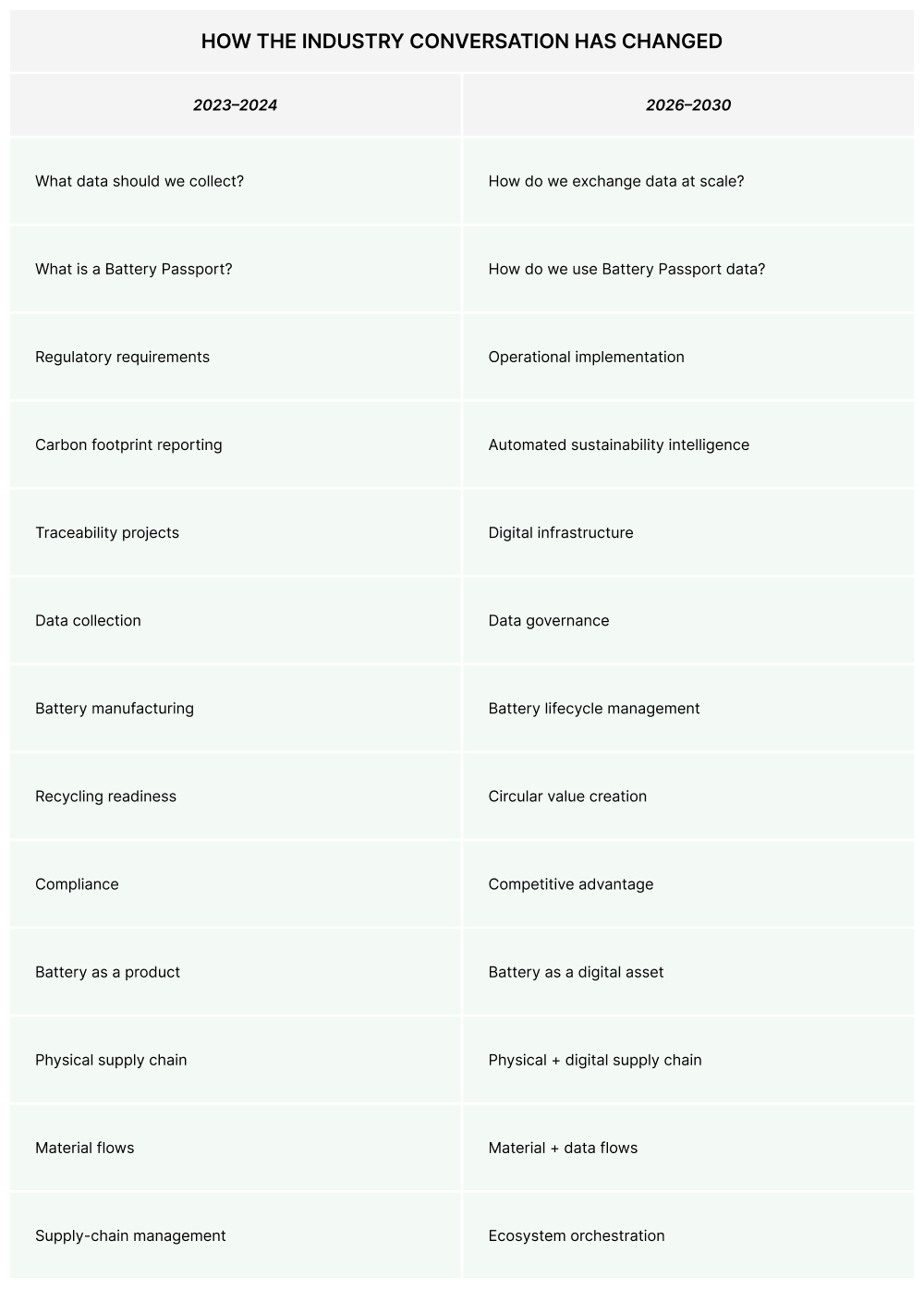
These challenges illustrate a broader shift taking place across the battery industry. A few years ago, discussions focused primarily on what data should be collected to satisfy future regulatory requirements. Today, as Digital Battery Passports move into the implementation phase, the challenge is no longer data collection itself, but the creation of interoperable digital infrastructure capable of supporting trusted data exchange across the battery lifecycle.
Industry experts increasingly agree that Digital Battery Passports are evolving beyond compliance tools. Over time, traceability platforms, digital twins, Digital Battery Passports, and connected data ecosystems are expected to become the digital backbone of the battery industry, enabling transparency, circularity, second-life applications, and more informed decision-making throughout the value chain.
What’s Next?
The battery industry is entering a new phase of maturity. After years of discussions around regulations, sustainability requirements, and Digital Battery Passport concepts, the focus is increasingly shifting toward implementation, interoperability, and long-term digital infrastructure.
While experts may differ in their views on specific technologies, regulations, or market developments, several common themes consistently emerge when discussing the future of the battery industry. Transparency, circularity, digitalisation, and data-driven decision-making are increasingly viewed as the key forces shaping the next decade of battery supply chains.
Full supply-chain transparency is becoming unavoidable
While regulatory approaches differ across regions, a common trend is emerging worldwide: battery manufacturers are expected to have significantly greater visibility into their supply chains than ever before. Whether driven by sustainability requirements, carbon footprint calculations, due diligence obligations, critical mineral sourcing rules, or industrial policy incentives, companies are increasingly required to understand where materials originate, how they are processed, and how they move throughout the battery lifecycle.
This shift is extending traceability requirements beyond battery manufacturers alone. Mining companies, refiners, material producers, cell manufacturers, OEMs, and recyclers are all becoming part of a growing battery data ecosystem, where information exchange is increasingly necessary for both compliance and business operations.
“EV producers have to know their entire supply chain and where materials come from, from mining up to the recycling phase. Suppliers, including battery cell and pack producers, chemicals companies, and recyclers also have to adapt to the requirements and enable data collection throughout the whole battery life cycle. Not only due diligence but CO2 calculation discussions are already taking place. This means that the EV and battery market will go towards full transparency between supply chain participants, sooner or later.”
A More Circular and Connected Battery Ecosystem
Growing attention to resource efficiency, supply chain resilience, second-life applications and responsible sourcing is changing how companies think about battery value creation. At the same time, digital technologies are enabling new forms of collaboration, visibility and decision-making across the battery lifecycle.
Looking ahead, many industry experts expect battery supply chains to become increasingly regionalised, circular and data-driven, creating new opportunities for both sustainability and business innovation.
“Over the next decade, the battery supply chain is expected to evolve towards increased circularity, regionalised production, and enhanced transparency enabled by digitalisation. Advances in recycling technologies, second-life applications, and responsible sourcing practices will reshape material flows and value creation. Data-driven decision-making and cross-sector collaboration are likely to strengthen resilience, traceability, and environmental performance across the value chain.”

Digital Infrastructure Will Become the Backbone of the Battery Ecosystem
As battery supply chains become more transparent, circular, and interconnected, the role of digital infrastructure is expected to grow significantly. Collecting battery data is only the first step. The greater challenge lies in ensuring that information can move efficiently between manufacturers, suppliers, OEMs, recyclers, regulators, and other stakeholders throughout the battery lifecycle.
Industry experts increasingly view Digital Battery Passports not as standalone compliance documents, but as part of a broader digital ecosystem that enables traceability, lifecycle management, and informed decision-making. Over time, these systems may become a foundational layer supporting transparency and collaboration across the entire battery value chain.
“Over the next decade, the battery value chain will undergo significant structural, geographic, and technological changes, driven by rising demand, geopolitical factors, and increasing sustainability requirements. Digital traceability solutions, including, particularly battery passports, will play a crucial role in the future ecosystem by enabling transparent lifecycle tracking across the entire supply chain. These systems will improve visibility and accessibility of the data for the general public, manufacturers, regulators, customers, and other interested parties to create a digital backbone of democratized data.”
The Future Is Automated Battery Data
As battery supply chains become increasingly digital, transparent and interconnected, Digital Battery Passports are beginning to evolve beyond regulatory compliance tools. What started as a mechanism for demonstrating provenance, sustainability and conformity is gradually becoming part of a larger digital infrastructure supporting battery lifecycle management.
“By 2035, we envision a total shift from a linear "mine-to-discard" model to a circular, value-based ecosystem where the "hunt for data" we experience today is replaced by standardized APIs and automated data flows. In this future, filling out a Battery Passport will evolve from a manual document assessment into a seamless "copy-paste" or direct upload process, where only the unique dynamic health data needs to be retrieved per unit.”
“The Battery Passport will enable a new era of predictability, allowing operations and commercial teams to use real-time data to instantly decide if a battery should be repaired, transitioned to stationary storage, or sent for high-grade recycling”
Final Thoughts
The future battery industry will not be built on Battery Passports alone. It will be built on the ability of organizations to exchange trusted information across increasingly complex and interconnected supply chains. As regulations mature and digital ecosystems evolve, Digital Battery Passports are likely to become less visible as standalone compliance tools and more important as part of the underlying infrastructure that supports transparency, circularity, and lifecycle management.
The companies that invest today in data quality, interoperability, and traceability will be best positioned to compete in the next generation of the battery economy.
