Grupo Andrés is one of Spain's leading tyre distributors, moving a high-volume, multi-brand portfolio between manufacturers, logistics networks, workshops and end customers. That position gives them visibility of a tyre's lifecycle that almost nobody else in the chain has.
It also raises a critical question. Could that information travel with the product itself, in a Digital Product Passport?
We ran a project with them to find out. This is what we built together, what their existing data actually supported, and what it tells other tyre distributors and importers about where to begin.
1. Who Grupo Andrés are, and what they wanted to build
Grupo Andrés sits at the intersection of manufacturers, workshops, fleets and logistics operators. Very little of what a tyre passport would need originates with them, but almost all of it passes through them. It's a pretty demanding place to sit commercially, and actually an unusually good one from which to organise product information.
Their vision for the project was a manufacturer-neutral passport model: trusted information that accompanies an individual tyre and, over time, connects product data with service history, retreading, circularity and end-of-life information. Not simply a static record of what a tyre was when it left the factory, but a structured set of product data that keeps growing as the tyre moves through its life. The project was carried out as part of DriveMatrix, the tyre-sector data space promoted by Grupo Andrés, which is designed to let manufacturers, distributors, workshops and recyclers share product information under common rules while each keeps control of its own data.
Crucially, they wanted to test the model against real data and real ownership boundaries, rather than a theoretical version where every supplier already cooperates and every field is already populated. That gave them space to test the underlying model responsibly, build internal knowledge, and identify a realistic path forward without assuming that regulation, supplier readiness or operational processes were already complete.
2. The regulatory picture: ESPR, EUDR and tyre DPP readiness
At present, we see two regulations sitting behind this work, each on quite a different timeline.
ESPR is the framework for the passport itself. The Ecodesign for Sustainable Products Regulation introduces Digital Product Passports (DPPs) progressively, product group by product group. The Commission's first Working Plan, adopted in April 2025, names tyres as one of six priority product groups alongside textiles, furniture, mattresses, iron and steel, and aluminium.
The dates deserve precision, because they're widely misreported:
- The tyre delegated act is indicatively expected around 2027. That's when the Commission aims to adopt the rule, not when anyone has to comply.
- The DPP obligation typically applies around 18 months after adoption, putting tyre passports in the 2028–2029 window.
- Both are indicative. Binding data fields arrive with the delegated act, informed by the Joint Research Centre's preparatory study on rolling resistance, wet grip, abrasion, recycled content and end-of-life routing.
In short, a tyre Digital Product Passport is not yet mandatory under a final tyre-specific ESPR act. The final information requirements and the legally binding application timeline will both be set by those future product-specific rules.
EUDR is the nearer regulatory milestone. The EU Deforestation Regulation will apply from the 30th of December 2026 to large and medium operators and traders, with micro and small operators generally following from 30 June 2027, after the postponement agreed in Regulation (EU) 2025/2650. Rubber is a covered commodity, and new pneumatic rubber tyres (CN 4011) are included in Annex I.
For tyre supply chains, EUDR creates specific traceability data requirements that are directly relevant to the emerging tyre DPP. The tyre ESPR preparatory study explicitly identifies “geospatial traceability for natural rubber sourcing under EUDR” as an existing data requirement to be considered in the DPP data framework. It also envisages DPP information at model, batch and item level, which makes batch-level association particularly relevant for material-origin and traceability information.
The two should be treated as complementary rather than interchangeable. Selected EUDR-relevant information, such as natural-rubber origin, batch references, and links to compliance records, can be associated with a tyre Digital Product Passport. The underlying geolocation evidence, risk assessment and Due Diligence Statement stay part of the operator's EUDR compliance process. Thus, we see that a DPP can provide a structured traceability and information-access layer, but it does not replace the Due Diligence Statement (DDS) or the operator's due-diligence obligations.
3. Why tyre data is harder than it looks
Information relevant to a tyre passport doesn't sit in one place. In practice it sits in three, with different owners and different timing:
- Product specifications: often already in ERP and catalogue systems, and (hopefully) in better shape than people expect.
- Origin, substances of concern and sustainability evidence: are typically held by manufacturers, not importers and distributors.
- Service, retreading, collection and end-of-life records: are generated later, by different actors entirely.
An importer running a multi-brand portfolio at volume has partial visibility of all three and outright ownership of essentially none. That's a governance problem as much as a technical one, and it's the reason "just export the data" doesn't often work.
4. What the project set out to do
We deliberately kept the scope bounded, with the project focused on one practical question: how much of a tyre Digital Product Passport could be built from information already available, and what additional data, governance and integration steps would be needed to scale?
Specifically, we set out to:
- Develop and implement a tyre-specific DPP model and structured data template.
- Assess whether existing ERP and catalogue information could populate passports efficiently.
- Map data ownership and responsibilities across Grupo Andrés, manufacturers and lifecycle contributors.
- Explore how EUDR Due Diligence Statement references could be associated with relevant tyre records as supporting evidence.
- Prepare a foundation for batch creation, future interoperability and integration.
The point was to build something real and learn from it.
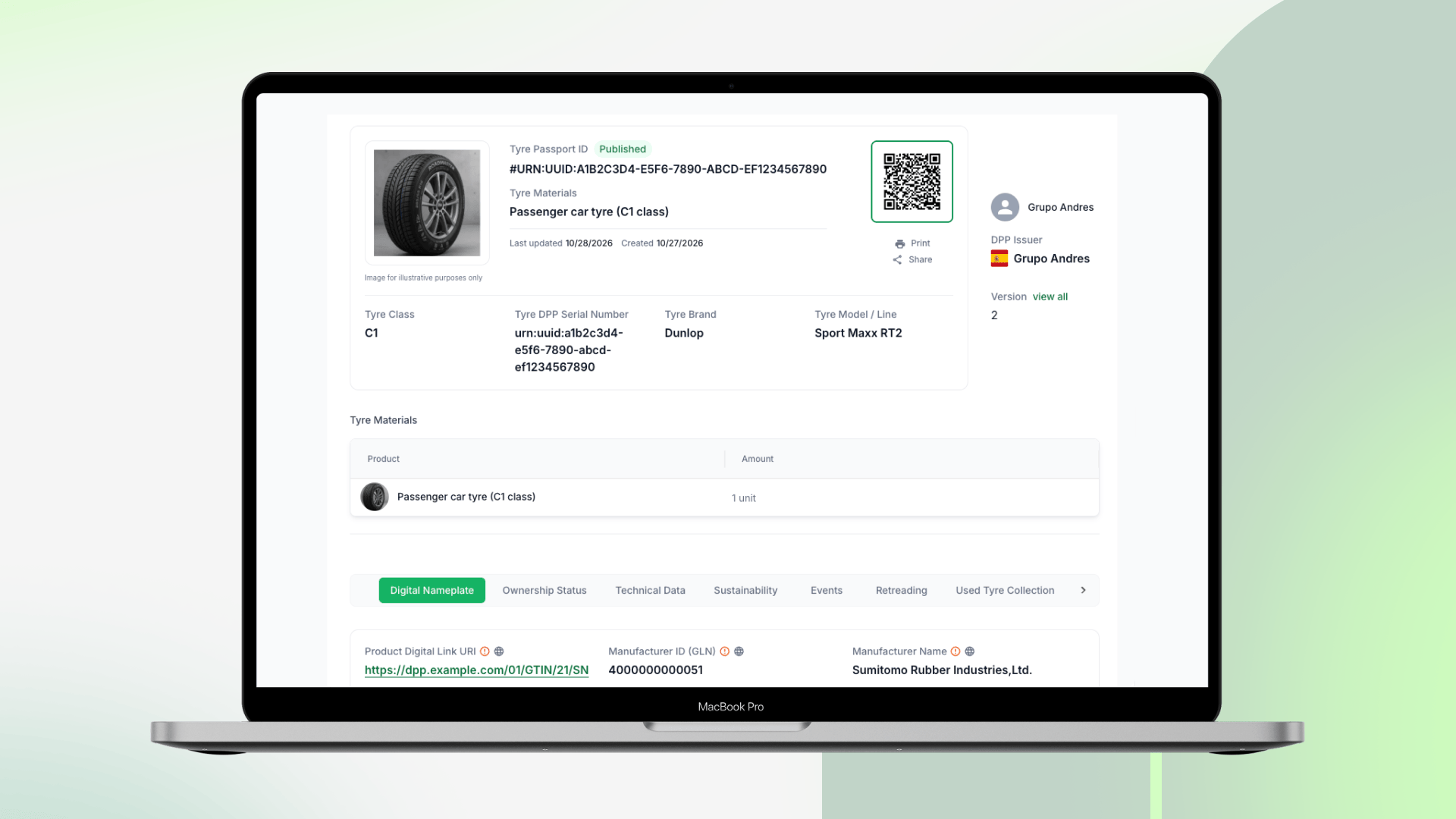
5. The model we built
We translated those requirements into a structured passport template on the Minespider platform. The design decision that mattered most was separating reusable product data from information that changes over the life of an individual tyre. That’s because those two categories have different owners, different update frequencies and different levels of confidence attached to them.
The model covers:
- Product identification and digital nameplate information
- Technical specifications and EU tyre-label data
- Sustainability and compliance evidence, including references to supporting documentation
- Ability to include custody and lifecycle-event records
- Ability to include workshop, retreading, collection and end-of-life information
- Operational links to support future data exchange and interoperability, with the passport structure aligned with the DPP data model defined for the DriveMatrix data space.
Alongside the template we used a batch-import structure and sample passports, and reviewed Grupo Andrés' existing catalogue data against the passport structure field by field.
6. What the project showed
The project established a practical foundation for future tyre DPP implementation. It also confirmed that Grupo Andrés already holds a valuable base of product information capable of supporting future passport creation. What it added was a way of organising that information by purpose: reusable product data, supporting evidence and lifecycle updates.
Grupo Andrés came out of it with a clearer view of how their existing product knowledge can be organised, how external contributors may participate, and how the approach can be scaled in a controlled way.
Concretely, we saw that the project delivered:
- A tyre-specific DPP model implemented on the Minespider platform.
- A structured batch-import template and sample passports.
- A review of existing product information against the proposed passport structure.
- Defined roles for Grupo Andrés, manufacturers and lifecycle actors.
- Relevant compliance evidence translated into a workable information logic.
- A phased roadmap for data improvement, integration and broader rollout.
From that list, we developed four key takeaways:
1. Existing catalogue data goes further than expected. The constraint wasn't data availability, it was structure and ownership.
2. Organising by purpose beats organising by source. Reusable product data, supporting evidence and lifecycle updates behave differently and need to be governed differently. Once we split them, most of the governance questions answered themselves.
3. Ownership mapping is the deliverable many people underestimate. Knowing which fields depend on a manufacturer and which you control outright tells you exactly where to spend time on supplier engagement effort, and where you can move forward without anyone's cooperation.
4. Compliance evidence translates into a workable information logic. EUDR references, product documentation and manufacturer declarations can be associated with the right records rather than living in a shared drive somebody has to search.
The central learning was that preparation can start before every regulatory detail is final. Existing catalogue data forms the reusable core, while manufacturer-supplied evidence and lifecycle updates are added progressively as requirements and collaboration models mature.
7. Scaling in phases: data coverage, integration and lifecycle collaboration
The DPP tyre project pointed clearly towards staged rollout following data maturity and operational readiness, rather than a single cutover. The progression we recommended:
1. Strengthen data ownership, validation and governance for the fields already under Grupo Andrés' control.
2. Deepen collaboration with manufacturers on priority product and sustainability information.
3. Extend the approach progressively across additional tyre categories and suppliers.
4. Develop lifecycle-information workflows with workshop, retreading and collection partners.
5. Advance towards automated, sovereign data exchange through the DriveMatrix data space, where each participant decides who accesses its data and on what terms.
6. Evaluate interoperability with other European data spaces and suitable data-carrier options (QR, RFID, NFC) for operational use.
Each step delivers something on its own, and thankfully none requires the previous one to be perfect.
8. Looking ahead: where tyre distributors and importers should start
For distributors and importers, DPP readiness isn't only a future compliance exercise. It's a way to hold product information, supporting evidence and lifecycle activity as one governed set of product data. This is clearly useful long before, and long after, any single deadline.
The honest starting point is an inventory, not a platform decision. Pull your ERP and catalogue fields, map them against the data categories under discussion for tyres, and simply mark each one: we own this, a manufacturer owns this, nobody currently holds this.
That third column is your supplier-engagement plan, and it carries the longest lead time. Manufacturer data conversations often run in months, not weeks.
Grupo Andrés' experience shows the value of a bounded project: use the data you have, identify your dependencies, clarify governance, and build an implementation path that can evolve as tyre-specific rules and market practice become clearer. Comply once, and the data keeps working for you afterwards.
About DriveMatrix
DriveMatrix is a federated data space for the tyre value chain promoted by Andrés Grupo Empresarial, S.L. It is built on European data-space standards, with a governance framework, a legal adhesion framework and an open catalogue of data products. drivematrix.es
This project was carried out within the project DRIVEMATRIX DATA SPACE (file TSI-100123-2024-111), supported by the Spanish Ministry for Digital Transformation and the Civil Service (Secretary of State for Digitalisation and Artificial Intelligence) under the second call for data-sharing space demonstrators and use cases (Sectoral Data Spaces Programme). Funded by the European Union – NextGenerationEU. Recovery, Transformation and Resilience Plan.

This case study describes an exploratory project. It does not constitute legal advice or a claim of compliance with future tyre-specific requirements. Regulatory dates cited are current as of publication; ESPR product-group timelines are indicative and subject to change.
Working out where your tyre data stands? Book a discovery call and we'll walk through the mapping with you.
Get in touch with our team


Recomended readings

Digital Product Passports: Preparing the Aluminium Industry for Future ESPR Requirements
Learn how Digital Product Passports will affect the aluminium industry under the EU Ecodesign for Sustainable Products Regulation.


The EU DPP Registry: What Economic Operators Need to Know
Learn how the EU DPP Registry will support Digital Battery Passports, what economic operators must register, and how the future European Digital Product Passport ecosystem is expected to function.

The EU DPP Registry Is Live: Guidance on What to Do Next
The EU Digital Product Passport registry went live on 19 July 2026. Implementing Regulation (EU) 2026/1778 requires a Qualified Electronic Seal before you can register a battery passport. Here is what that involves and what to do next.
