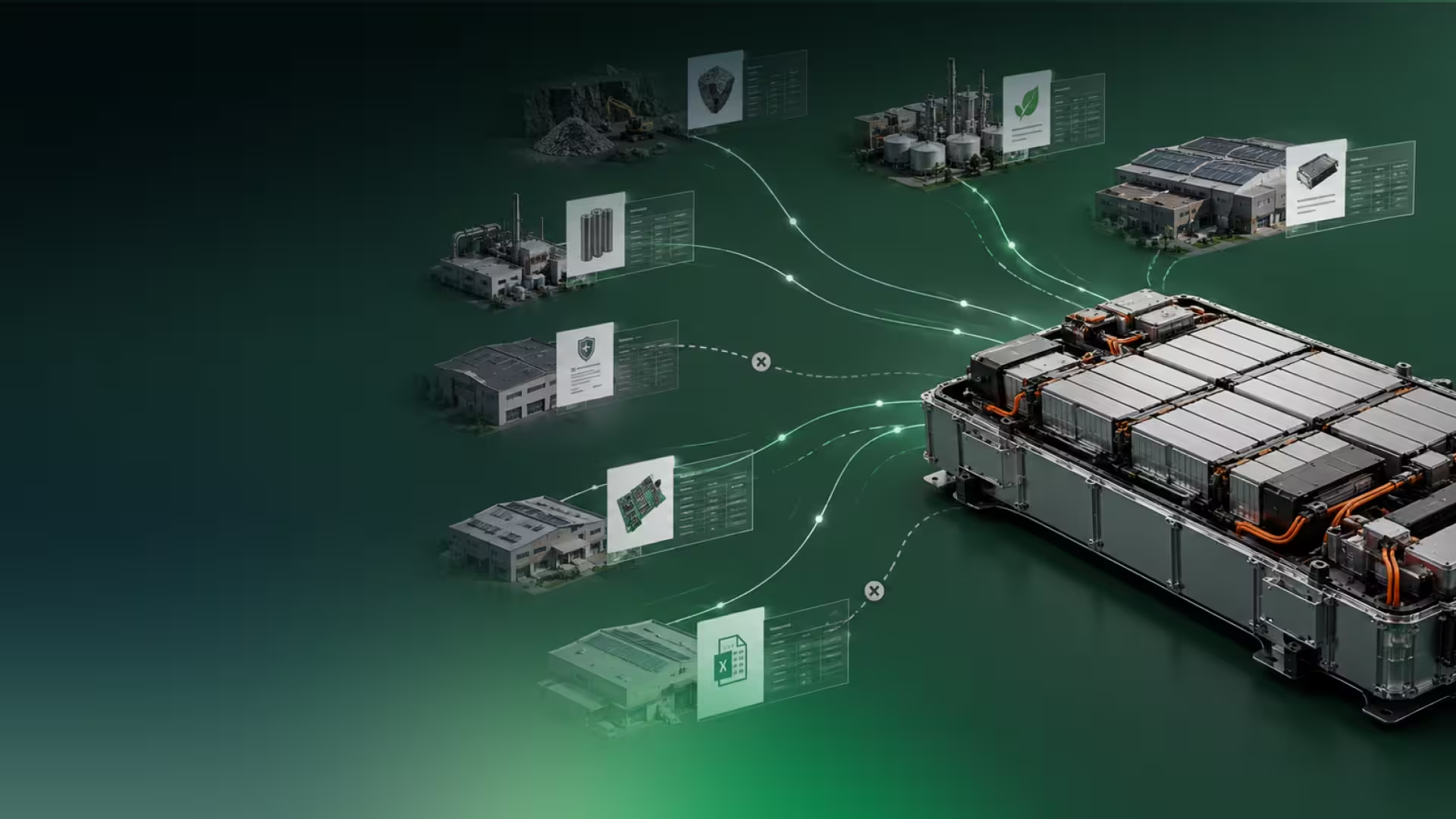
Most of us would agree that we’re entering an AI-driven era of work. Information that once had to be found, copied, formatted, and entered manually can increasingly be processed with AI (thankfully!).
At Minespider, we see that companies already hold much of the information that will feed their passports. It can be found in technical documentation, supplier certificates, spreadsheets, compliance records, product databases, and lifecycle systems. Yet turning that information into passport-ready data can still involve a surprising amount of manual work: opening documents, searching for values, copying them into fields, checking formats, and repeating the process across products and suppliers.
So over the past few years, we’ve been building some AI tools, including a Copilot, that can make a practical difference by reducing repetitive work.
For companies preparing for the EU Battery Regulation, we see it can make a big difference.
The AI Opportunity is Bigger Than Document Extraction
When people talk about AI and Digital Battery Passports, document extraction is an obvious starting point.
A supplier sends a certificate, a manufacturer uploads a technical specification, and the compliance team receives a declaration in a PDF. Traditionally, someone has to read those documents and transfer the relevant information into another system.
Instead of asking a person to manually copy information from a document into a passport field, an AI-assisted system can identify relevant information, structure it, and suggest where it belongs. The person can then review the result rather than performing the entire extraction process themselves.
But document extraction is only one part of the story. Digital Battery Passport preparation still depends on reliable source data, clear ownership, structured workflows, system integration, and human review.
Where AI Can Actually Help
The useful question is not whether AI can be added to a Digital Battery Passport platform. It’s where AI can make the workflow faster without taking decisions away from the people responsible for the data. There are several areas where this makes practical sense.
1. Extract Information From Existing Documents
Supplier and compliance information rarely arrives in exactly the format a Digital Battery Passport requires. Technical specifications, certificates, declarations, spreadsheets, and other documents can contain relevant information, but that information may be buried in different structures and formats.
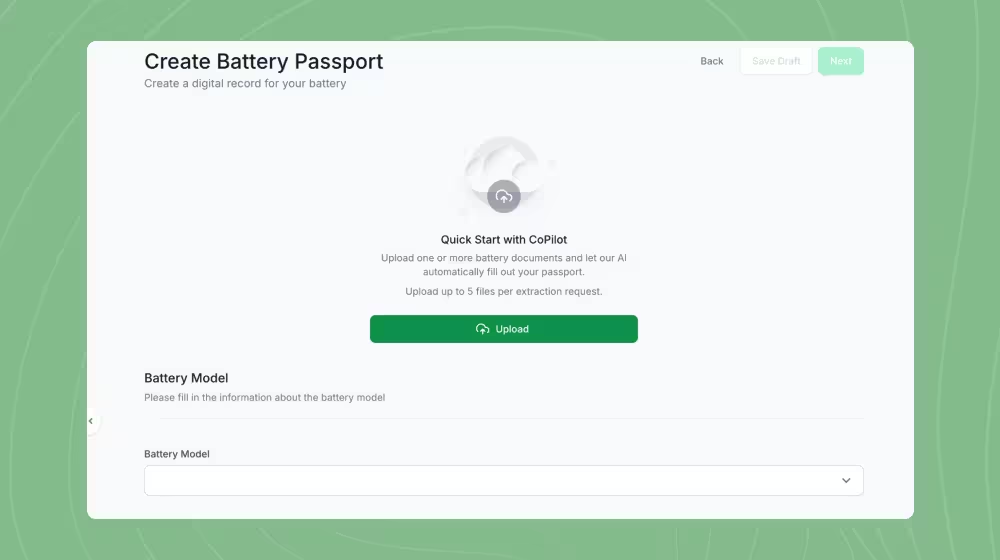
We built the Minespider Copilot to help with this step. Users can upload source documents, and Copilot can extract relevant information and use it to pre-populate Digital Battery Passport fields for review. Each field also shows how complete the information is as a percentage.
This means teams do not have to start with an empty passport and manually transfer every relevant value. The information still needs to be reviewed before it becomes part of the passport. The value is not that teams stop checking the data, but that they spend less time copying and formatting it, and more time reviewing, completing, and approving it.
2. Identify What is Missing
Once information has been collected, another problem becomes visible: data gaps.
A company may have most of the information required for a passport but still be missing specific supplier data, technical information, lifecycle data, or other required fields. Finding these gaps early is much more useful than discovering them when a passport is supposed to be published.
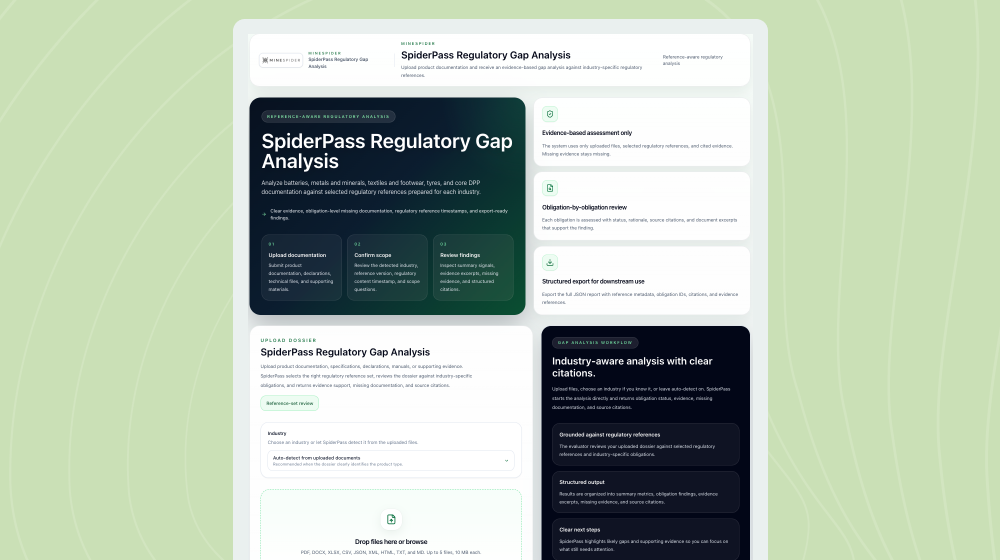
Minespider’s Regulatory Gap Analysis AI Tool helps companies assess their Digital Battery Passport readiness, identify data gaps, and understand what needs attention before implementation.
This changes the role of AI from simply processing information to helping teams ask a more useful question: What do we still need to do?
And the answer still requires input from suppliers, product teams, compliance specialists, or other internal stakeholders.
3. AI Assistant - Helping People Navigate the Work
Not every challenge in Digital Battery Passport implementation is a data-entry problem.
Teams also need to understand platform workflows, data requirements, and regulatory expectations. As requirements evolve, it can be difficult for everyone involved in implementation to keep track of what applies and what needs to change.
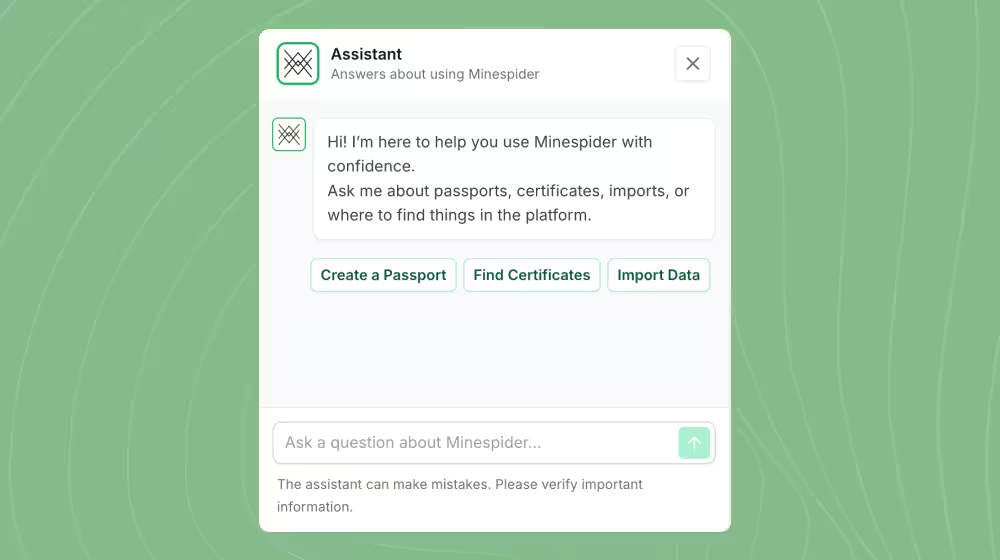
We built an AI Platform Assistant to help users navigate passport creation, data preparation, and the ever-evolving Battery Passport requirements. They are designed to make information easier to work with and reduce the amount of time spent searching for answers or figuring out the next step in a workflow.
AI Supports the Process, People Remain Responsible for the Data
There is an important difference between automating a task and automating responsibility. AI can extract a value from a supplier document, suggest where it belongs, highlight a potential gap, or help explain a requirement. But companies still need people who understand their products, suppliers, data, and regulatory obligations.
For Digital Battery Passports, this distinction is pretty essential. The quality of the passport depends on the quality of the underlying information, and that information still needs to be checked, completed, approved, and maintained by the organisation responsible for it.
AI Does Not Require Full Automation From Day One
There is another misconception worth challenging: that using AI means a company needs a completely automated data architecture.
A company can start with a few battery models, a collection of supplier documents, and a manual workflow. It can then introduce AI-assisted extraction where it saves time, move to batch imports as volumes increase, and eventually connect existing systems through APIs.
Minespider supports these different stages:
- Manual creation: For early exploration and individual passports
- Copilot: For AI-assisted extraction from source documents
- CSV/Excel batch import: For larger volumes of structured data
- API integration: For automated production workflows
These are complementary approaches, not steps that every company must follow in exactly the same order.
A team might use Copilot for document-heavy preparation while importing other data through Excel, for example. Later, API integration may make more sense for information that already exists in structured internal systems.
The important point is having options rather than assuming AI is the answer to every data problem.
Digital Battery Passports Are Not Static Documents
AI-assisted preparation is useful, but creating the passport is only one part of the overall process.
Battery information can change throughout the product lifecycle. A battery may be repaired, repurposed, transferred, or updated. Dynamic information can also come from systems such as a BMS.
That means the long-term challenge is not simply creating a passport once. It’s maintaining a reliable digital record as information changes.
Minespider supports version history and auditability, chain-of-custody relationships between connected passports, and API-based workflows for dynamic information such as State of Health, State of Charge, cycle count, and service information.
These workflows are not replaced by AI. They are part of the wider infrastructure needed to manage Digital Battery Passports over time.
From Manual Data Entry to Assisted Data Workflows
We see that Digital Battery Passport implementation will require coordination across products, suppliers, systems, and lifecycle stages. Making people manually move information from one place to another should not have to be the default for every part of that process.
AI offers us a way to rethink some of that work.
Minespider Copilot helps extract information from documents and pre-populate passport fields. Its AI-supported gap analysis and regulatory tools help teams understand what is missing and what needs attention. Manual creation, batch imports, and APIs provide other ways to manage passport data depending on the company's needs and level of integration.
The important shift is not simply from manual to AI. It's from manual data entry to assisted data workflows, where people spend less time on repetitive tasks and more time reviewing information, making decisions, and managing the processes that AI cannot replace.
Explore Where AI Can Support Your Digital Battery Passport Workflow
The starting point is not automating everything. It’s identifying where data gets stuck between documents, spreadsheets, suppliers, and internal systems and choosing the right workflow to move it forward.