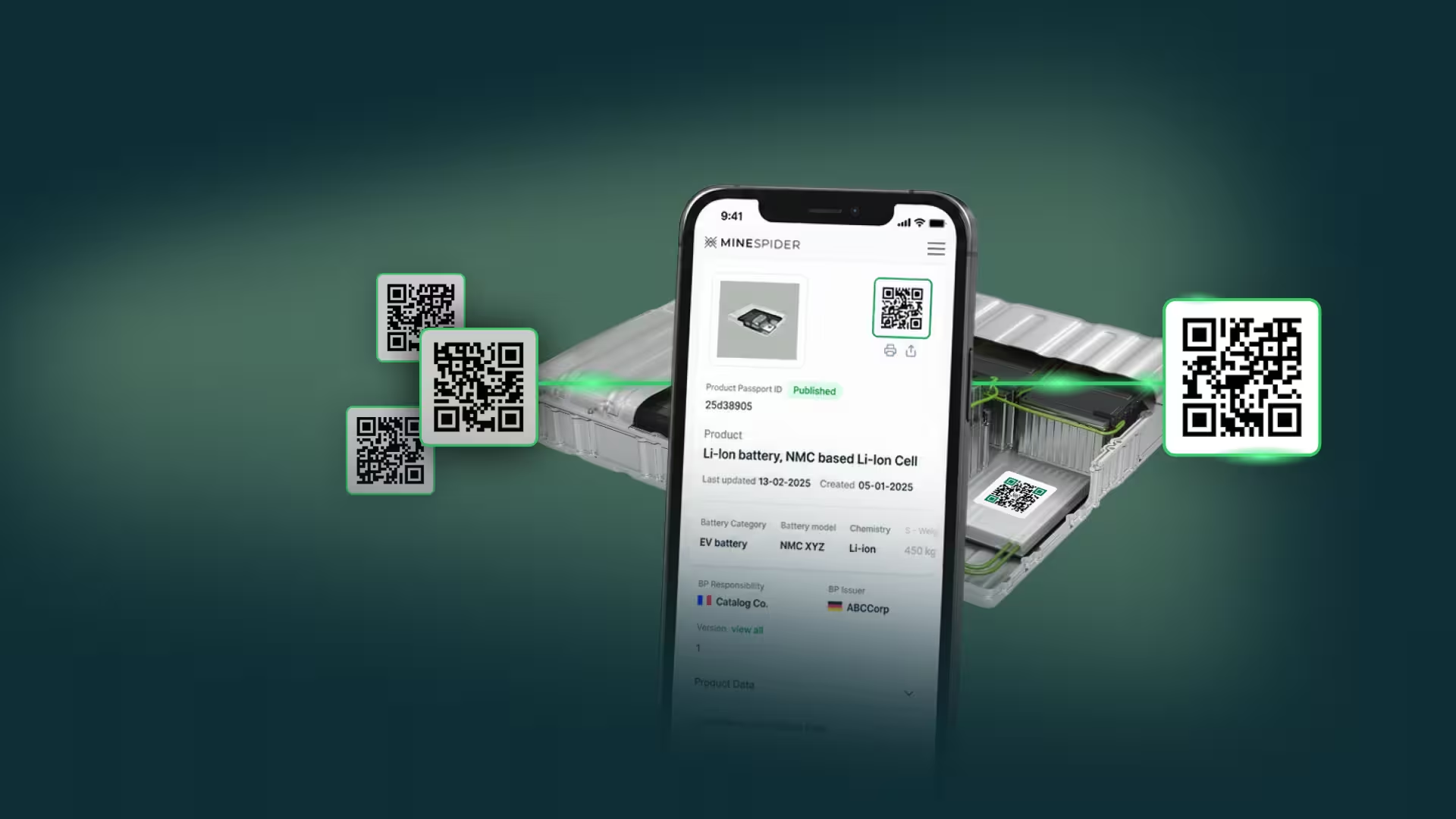
We've been getting a lot of questions at Minespider about the EU Digital Product Passport (DPP) Registry. How the EU Digital Product Passport Registry will fit into their Battery Passport implementation. What can they do today? What does their own company need to verify? And how much of the registration process can their passport provider support?
The Commission’s October publications give us more detail to work with. Companies can already enroll and verify their organizations, and implementation teams now have published API specifications, semantic data models, and authentication guidance. However, successful production registration still needs to be confirmed separately from the availability of those documents.
With the February 18, 2027 deadline approaching, here is what the latest guidance means for manufacturers and the work they can start now.
Key takeaways
- Organization enrollment and identity verification are available, including for companies working with a passport provider.
- The Commission published Registry API, semantic data, and authentication resources on October 30, 2026.
- Publication of those resources does not, by itself, confirm that production Battery Passport registration is available.
- An accepted registration request does not mean a passport is registered. The final processing outcome must be checked.
- The deadline remains February 18, 2027, for in-scope EV batteries, LMT batteries, and industrial batteries above 2 kWh.
Where does Battery Passport registration stand today?
The Commission’s Registry page provides access to organization enrollment and a separate testing environment. Manufacturers can begin the verification process and prepare the data and permissions their integration will need.
The September 2026 Registry User Guide described successful Battery Passport registration as unavailable because the battery-specific semantic catalog had not yet been defined. That warning predates the October technical publications and should be read as a historical status description.
The Commission has now published the semantic resources and API documentation. The October API guide also includes a Batteries/EV submission example and explains how to submit DPPs and monitor validation. This is a meaningful step forward from the September documentation. However, the Commission's public Registry page does not separately confirm that successful Battery Passport registrations are already being completed in the production environment. Until that is confirmed, manufacturers should distinguish between preparing and testing an integration and completing a production registration.
The Registry also has a different role from the platform hosting the passport. It records identifiers, registration information, and related metadata. During validation, it retrieves the hosted passport without retaining the fetched passport payload. The detailed battery information continues to be maintained by the responsible Economic Operator or its authorized provider.
What updates did we get in October?
The Commission’s DPP Resources and Documentation page now includes six Registry technical publications released on October 30, alongside updated battery data guidance. The main developments since the September webinar are:
The technical publications are available through the Commission’s resources page. The proposed access rules are open for feedback through the Have Your Say consultation.
Publication of these documents gives companies a basis for preparing integrations. It does not, by itself, confirm that successful production Battery Passport registration is available.
What must manufacturers do for organization verification?
The Registry needs to establish the identity of the Economic Operator responsible for the battery. Using a passport provider does not remove that step.
The published portal procedure uses EU Login and a PDF declaration bearing a Qualified Electronic Seal (QSeal) for a legal entity or a Qualified Electronic Signature (QES) for a natural person or sole trader. The legal framework permits other eligible verification methods; their availability should be checked in the Registry. The Commission’s User Guide for Economic Operators explains the documented onboarding procedure.
Organization verification establishes who is responsible. It does not certify that a battery, or every entry in its passport, meets all regulatory requirements.
Customers also ask whether a DPP provider can support the Registry process. The published service-account model provides a way for verified Economic Operators to connect their systems to Registry services through machine-to-machine authentication. A provider can support the technical integration and passport workflow under the appropriate authorization, while the responsible Economic Operator remains in control of the required credentials and remains responsible for registration. We are reviewing how this workflow can be supported through Minespider.
Providers can assist with passport creation, hosting, and maintenance under written authorization. However, for Battery Passports, the Economic Operator placing the battery on the EU market remains the responsible registering operator. Authorization does not transfer that responsibility to the provider.
"Manufacturers should not treat the battery passport as something they finish in February 2027. Batteries can remain in use for years, and the information around them will change. The economic operator is the one who is responsible for maintaining the battery passport throughout the life of every battery they put on the market. But we will be there to support them every step of the way."
- Nathan Williams, Founder & CEO of Minespider
Can existing identifiers and QR codes still be used?
Existing identifiers and QR codes may be suitable if they meet the applicable requirements. For Registry submission, the Unique Product Identifier must be provided as a resolvable HTTPS URL. An internal serial number can form part of a compliant identifier structure, but it cannot serve as the complete Registry submission value on its own.
The QR code provides access to the hosted passport and does not need to point directly to the Registry. Successful registration produces a separate Registry identifier.
EN 18219:2026 on unique identifiers and EN 18220:2026 on data carriers are already among the DPP standards cited in the Official Journal under the ESPR through Implementing Decision (EU) 2026/1736. This publication supports the DPP requirements under the ESPR. It should not be read as a battery-specific implementing measure or as changing the requirements of the Batteries Regulation. Manufacturers should assess their existing identifiers against the requirements applicable to Battery Passports and the published Registry specifications.
How does the documented registration process work?
The API Integration Guide describes JSON submissions containing one DPP item or a batch of up to 100 items. Each item must include its own unique product identifier, and all items in a submission must share the same product classification. The organization must be verified, and the submitting user or system must have the necessary permissions.
Processing is asynchronous. A 202 Accepted response means the Registry has accepted the request for processing, not that registration is complete. The submitting system must track the task until processing finishes and check the business outcome. Only a successful outcome confirms that the DPPs have been registered.
Submissions are all-or-none. If one or more DPP items fail validation, none of the items in that submission are registered. The invalid entries must be corrected and the complete set resubmitted as a new request.
The September User Guide also describes individual and bulk procedures through the web interface. These are separate from the published API contract, and their current availability and supported formats should be checked against the operational Registry.
For manufacturers already creating passports through a provider, this gives the integration work a concrete reference: how to submit registrations, confirm outcomes, and handle validation failures within existing workflows.
Which batteries need an individual passport?
From February 18, 2027, the obligation applies to each electric vehicle battery, each light means of transport battery, and each industrial battery with a capacity greater than 2 kWh placed on the market or put into service. The capacity threshold applies to industrial batteries.
The relevant unit is the finished, safely functioning battery. Several packs that depend on a shared Battery Management System or other essential components may together form one battery. Packs that function independently must be assessed separately.
That distinction matters when translating an internal product hierarchy into passport records. Tracking a cell or module internally does not automatically mean it needs its own registered passport.
There is no blanket retrospective requirement for batteries placed on the market or put into service before the deadline. Subsequent repurposing, remanufacturing, or preparation for reuse can trigger new passport obligations when the relevant requirements apply. Where a previous passport exists, the new passport must link to it. A simple repair does not normally require a new passport.
What data should be prepared for February 2027?
The Commission’s Battery Passport data guidance, version 3.2, identifies 71 numbered entries and explains their applicability across battery categories. These are not 71 mandatory, distinct fields for every battery. Some information is optional, conditional, or linked to later requirements.
The guidance is intended to support implementation, but it does not create additional legal obligations. Its disclaimer also states that the document should not be considered representative of the European Commission's official position.
Its clarifications include more precise data formats, a new optional discharge C-rate data point (40), a clearer description of data point 47 covering component part numbers and replacement-spare sources, clarification of access to certain restricted information for notified bodies and Member State authorities, more specific industrial-battery applicability, and histogram formats for data points 70 and 71.
The guidance helps manufacturers distinguish between the information needed for the initial passport and information that is conditional, optional, or subject to later requirements:
These distinctions follow the Commission’s current data guidance and explanations of initial and later-applicable information.
Renewable content is separate from recycled content: the guidance marks the share of renewable content as mandatory for EV, LMT, and industrial batteries.
Relevant dynamic information needs updating when a change in battery status occurs or is being considered. Continuous real-time transmission is not prescribed for every battery. For some data, such as state of health, more frequent updates may be appropriate where technically feasible and proportionate.
The Battery Passport guidance helps manufacturers identify which information applies to each battery category. The Registry's semantic resources explain the technical models, vocabularies, and validation mechanisms used to structure and check DPP data. Together, they give manufacturers and providers a clearer basis for mapping existing data to the Registry's requirements.
What is changing around access to restricted information?
The Batteries Regulation divides Battery Passport information into public data and restricted categories. Some restricted information is reserved for notified bodies, market surveillance authorities, and the Commission, while other parts may be accessed by people with a legitimate interest for specific purposes.
On October 19, 2026, the Commission published a draft implementing regulation further specifying access under Article 77(9). Its Have Your Say consultation closes on November 16, 2026. As of this update, the draft has not been adopted.
The proposed access groups vary by information type. They cover activities such as repair, repurposing, remanufacturing, and recycling, with individual-battery information also available to purchasers and parties acting on their behalf.
The draft regulation sets permitted purposes, limits how long downloaded information can be retained, and defines sharing exceptions. Purchasers and parties acting on their behalf may also use individual-battery information to make batteries available to independent energy aggregators or energy market participants. Designated recipients of safety information would have broader rights to use, download, share, publish, and reuse it.
Companies can use the proposal to prepare their access controls while allowing for changes in the final rules. Our Battery Passport access-rights article explains the proposed groups and conditions in more detail.
What should manufacturers prioritize now?
The published specifications allow preparation to become more specific. We recommend five priorities:
- Confirm the responsible organization and administrator. Identify the legal entity responsible for the finished battery and who will manage verification, permissions, and credentials.
- Check the finished-battery level and identifiers. Establish which products need individual passports and whether existing identifiers and QR codes meet the applicable requirements.
- Map the applicable data. Use the category guidance and semantic models to identify the information required, where it is held, how it must be formatted, and who owns any gaps.
- Prepare access and lifecycle updates. Define how public and restricted information will be managed and how changes during use, repair, repurposing, and end of life will be recorded.
- Plan registration and outcome monitoring. Work with your provider on submissions, validation failures, and confirmation of successful registration against the applicable production workflow.
A Battery Passport is not a one-time data submission. Batteries can remain in use for years, and the information associated with them may change throughout their lifecycle. Planning for those updates is part of the implementation work companies need to do now.
At Minespider, we are reviewing the October publications against our platform capabilities and Battery Passport data structure. Our review covers data mappings, validation, secure access, and the documented registration workflow, including how customer verification and authorization can be supported with as little additional administrative work as possible.
We will keep customers informed when developments affect their implementation or require further action. To discuss how these requirements fit your existing systems and battery data, contact our team.
Frequently asked questions
Can companies start using the DPP Registry now?
Companies can enroll and verify their organizations and use the separate testing environment. API, semantic-data, and authentication documentation is also published. These steps support preparation; successful production registration must be confirmed through the applicable operational workflow.
Who remains responsible when a provider helps?
The Economic Operator placing the battery on the EU market remains responsible for registering the Battery Passport. Another operator may be authorized in writing to create or update passport information, but this does not transfer the Economic Operator's legal responsibility. The Commission distinguishes these tasks from DPP Registry registration, which must be carried out by the responsible Economic Operator.
Where is the complete passport stored?
The detailed passport remains hosted by the responsible operator or its provider. DPP Registry retains identifiers, registration records, and metadata, and retrieves the hosted passport for validation without keeping the fetched payload.
What about batteries placed on the EU market or put into service before February 18, 2027?
The deadline does not create a blanket retrospective requirement. Later repurposing, remanufacturing, or preparation for reuse may trigger a new passport obligation when the relevant requirements apply. A new passport must link to its predecessor where one exists; a simple repair does not normally require a new passport.
Is the Registry identifier required in a battery customs declaration?
The Commission’s battery FAQ says the DPP Registry registration identifier does not need to be entered in electronic customs declarations for Battery Passports. The passport must still be registered when the obligation applies.