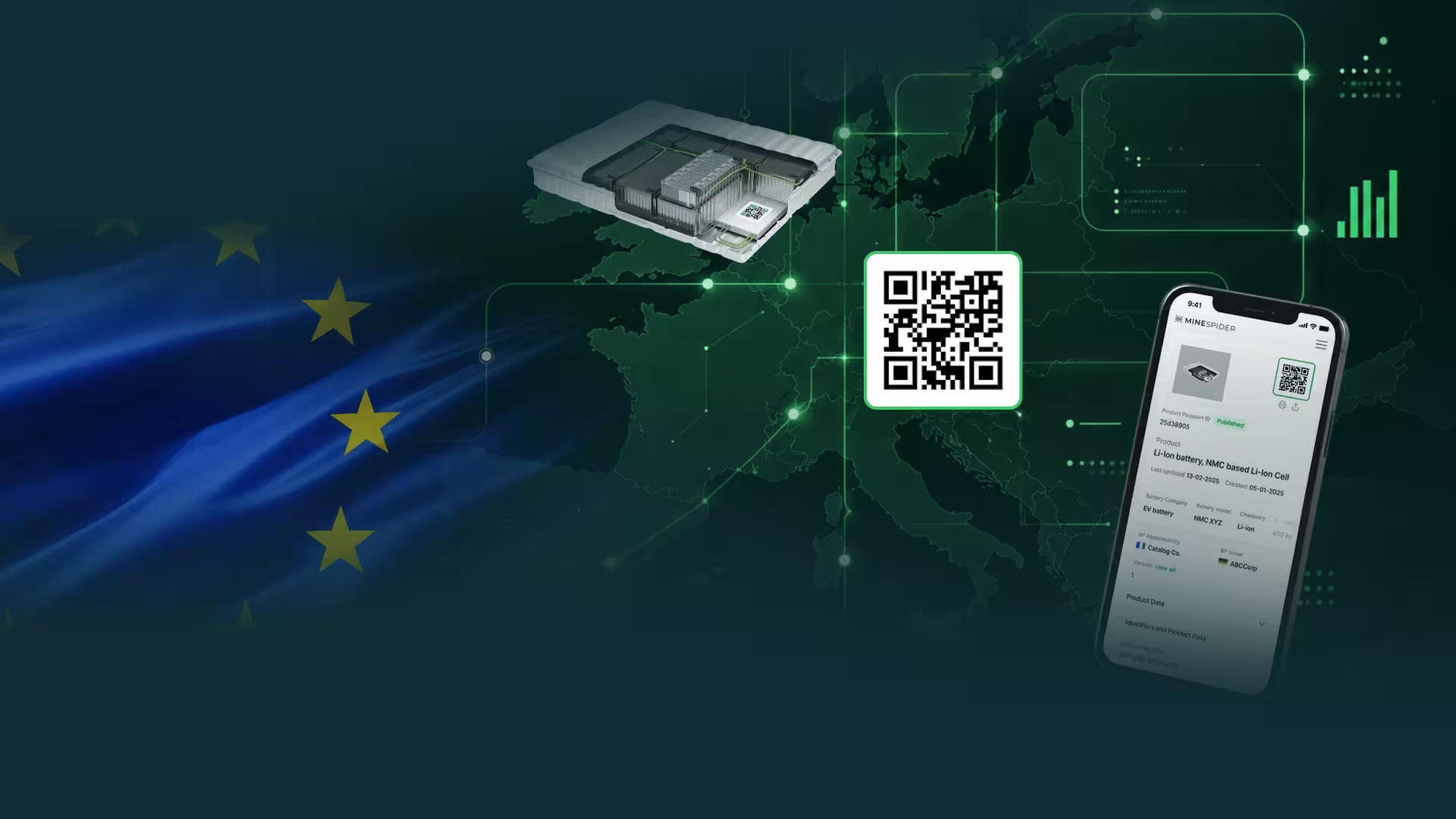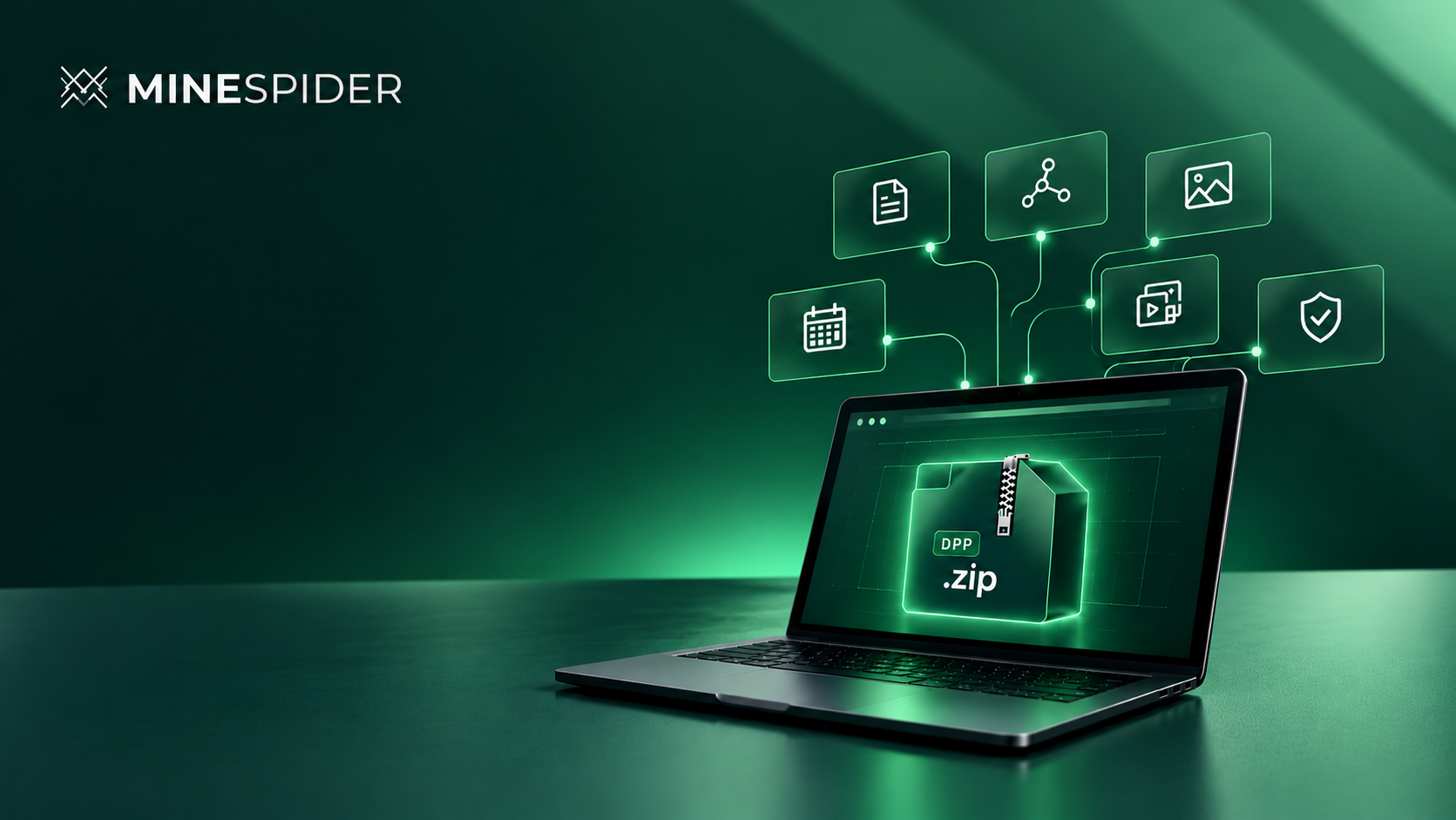
Open DPP Packager is an open-source tool from Minespider, featured in the CIRPASS open-source DPP catalogue, that packages Digital Product Passport data into a portable ZIP file. This allows passport data to be backed up, migrated, inspected and validated outside the platform that created it.
Digital Product Passports are becoming a fundamental part of the infrastructure behind product data. As companies prepare for requirements under the Ecodesign for Sustainable Products Regulation (ESPR) and the EU Battery Regulation (EUBR), the conversation is moving beyond what data belongs in a passport, to: What happens to data when it needs to leave the system that created it?
Increasingly we see (thanks to new delegated acts) that a passport may need to be backed up, migrated to another platform, inspected during an audit, transferred between organizations, or used for interoperability testing. A technical team may need to inspect the data without having access to the original DPP platform. A backup provider may need to store a complete package that can later be restored or understood independently.
A database backup can protect against data loss, but it does not necessarily provide a portable, inspectable package that another system can work with.
That is the gap the Open DPP Packager is designed to address.
What is the Open DPP Packager?
Open DPP Packager is an Apache-2.0 licensed TypeScript library and command-line interface (CLI) for creating, inspecting, and validating portable Digital Product Passport ZIP packages.
The idea behind it is straightforward: give DPP data a defined package structure that can travel between systems.
A package can contain a versioned manifest, passport documents, relationship and event files, supporting resources, media, JSON schemas, and SHA-256 integrity metadata. The package can then be inspected and checked without relying entirely on the platform that originally generated it.
The purpose is not to replace a DPP platform. It is to make the handoff layer more practical.
“When you build DPP infrastructure, you quickly run into the question of what happens when the data needs to move outside the platform that created it. Backup, migration, testing, and handoff all require more than storing a copy of the database. The package itself needs to be understandable, its contents need to be inspectable, and there needs to be a reliable way to check that what was received is what was sent. That is the problem we wanted to solve with the Open DPP Packager.”
- Nathan Williams, Founder & CEO, Minespider
Why do Digital Product Passports need to be portable?
DPPs are intended to work across organizations, systems, and stages of a product’s lifecycle. That makes interoperability more than a technical nice-to-have.
A passport could move from a manufacturer to another economic operator, be handed over during a lifecycle transition, be archived for future access, or be inspected by a system that was not involved in creating it.
In these situations, having the data available is only part of the problem. The receiving system also needs enough information to understand what it has received, check that the files are intact, and work with the package without having to recreate the original environment.
This is particularly relevant as DPP requirements develop around interoperability, transferability, open standards, and avoiding vendor lock-in. ESPR also includes requirements around making a backup copy available through a DPP service provider where DPP obligations apply.
The legislation does not prescribe one technical architecture for every backup or migration workflow. But the direction is clear: DPP data needs to remain usable beyond a single implementation.
Open DPP Packager addresses this at a deliberately narrow level: how the data itself can be packaged for handoff, backup, inspection, and interoperability workflows.
What's inside an Open DPP Packager file?
An Open DPP Packager archive can include the different pieces needed to describe and inspect a passport:
- Passport documents containing the core DPP information
- Relationship maps showing connections between passport records
- Event files capturing relevant lifecycle events
- Associated resources and media linked to the passport
- A versioned JSON manifest describing the package contents
- SHA-256 integrity metadata for checking files
- JSON schemas used as validation inputs
- Safe ZIP inspection without extracting package contents to disk
The format also supports a BatteryPass-Ready EU Battery Passport schema profile while keeping the underlying package structure provider-neutral.
That distinction matters, as the package format is not designed around only batteries. Other product categories can use the extension mechanism rather than requiring the core format to be redesigned around a single sector.
Where does Open DPP Packager fit in a DPP stack?
Open DPP Packager is not intended to become another DPP platform.
It is not the hosting layer, a backup-storage service, a legal compliance engine, or a system that verifies every claim contained in a passport.
Those responsibilities remain with the relevant DPP platform, backup provider, economic operator, or verification process.
The packager focuses on a smaller but useful layer:
Package the passport data. Describe what is inside. Check file references and integrity metadata. Give another system enough information to understand what it has received.
That narrow scope is intentional. Package formats do not need to be complicated to be useful. In fact, the more widely a format needs to travel, the more important it becomes that the structure is readable, predictable, and straightforward to implement.
Why open source?
The idea came from working on DPP backup and export workflows at Minespider.
If a package format is going to support handoffs between platforms, developers, backup providers, and other parts of the DPP ecosystem, it should not depend on one company controlling the format.
That is why Open DPP Packager is released under the Apache-2.0 license.
Open source gives other developers and organizations the opportunity to inspect the implementation, test the format, build integrations, and adapt it to their own workflows. It also means the package structure can be discussed and improved outside a single vendor environment.
For Minespider, the goal is not to make every organization adopt the Minespider platform. It is to provide a practical piece of infrastructure that can work alongside different DPP implementations.
How do you back up or migrate a Digital Product Passport?
Digital Product Passports will need to work across more than one platform, organization, and point in a product's lifecycle.
That makes portability increasingly important. A passport should not become difficult to move simply because it was created in a particular system.
Open DPP Packager takes a focused approach to that problem: a simple, open package format for moving, backing up, inspecting, and validating Digital Product Passport data.
It is a small piece of the wider DPP infrastructure, but one designed around a simple principle: when passport data needs to move, the package should be understandable outside the system that created it.