In May, DG GROW held a webinar on implementing the EU Battery Regulation (Regulation (EU) 2023/1542), and it gave companies the clearest picture yet of what the Battery Passport will require in practice. The headline: the obligation remains on track for 18 February 2027. With the central DPP Registry due to go live in July 2026 and most technical standards in final approval, battery manufacturers, automotive OEMs, and importers should now be turning the regulation into concrete data, system, and supplier-readiness work.
This post answers the five questions the webinar settled for regulatory, product, and supply-chain teams: who is responsible, where the data lives, who can see it, how much of it is needed on day one, and how cross-border data rules fit in.
Five Key Takeaways
- The deadline holds. From 18 February 2027, EV, LMT, and industrial batteries above 2 kWh cannot be placed on the EU market without a Battery Passport.
- Accountability stays with the economic operator (usually the EU manufacturer or importer), but technical operations can be delegated to an authorised operator in writing.
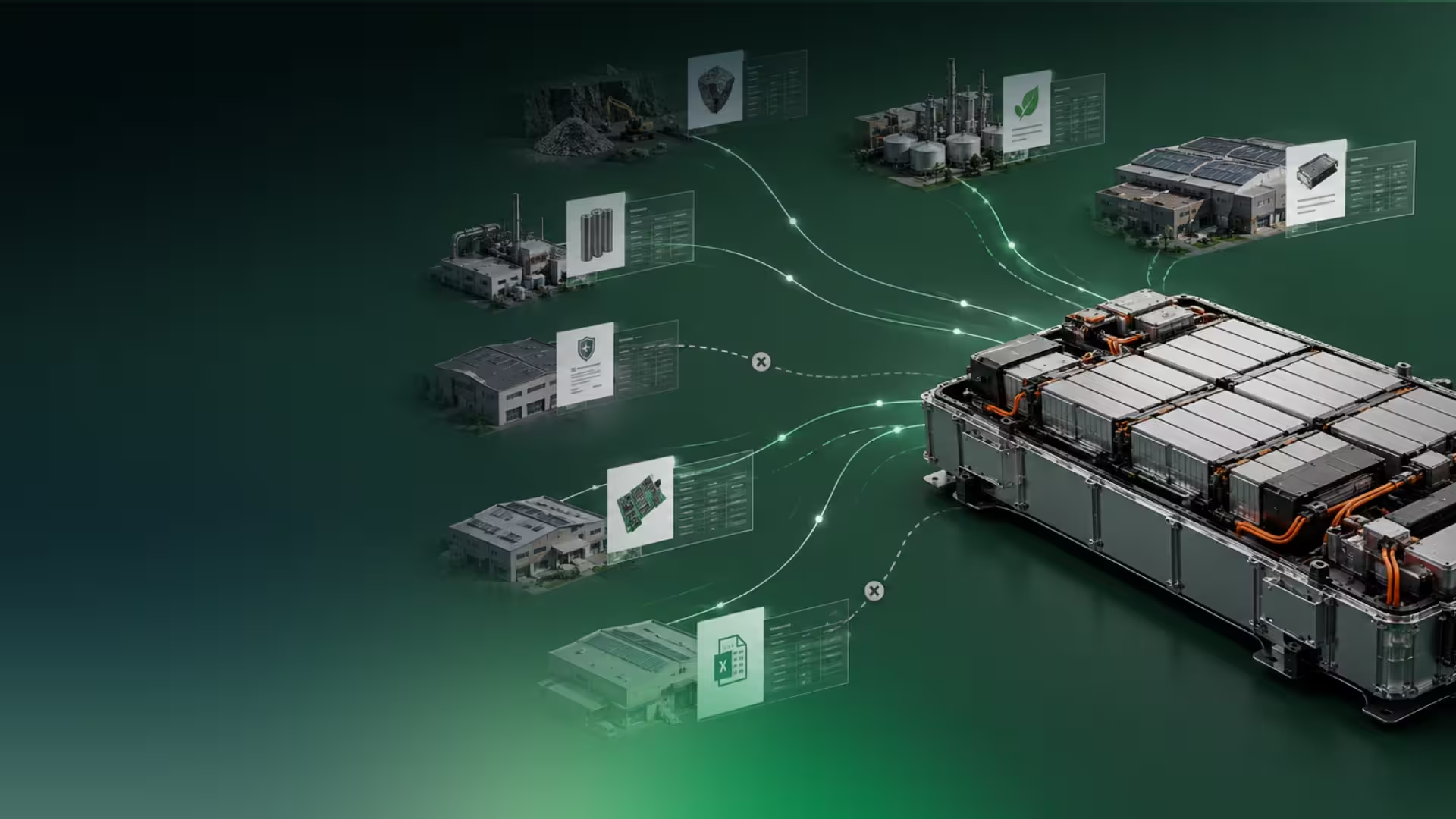
- The architecture is decentralised. The full passport dataset stays with the economic operator or its authorised operator; the central Registry is a discovery-and-identifier layer, not a data repository.
- Access is tiered, not all-or-nothing. Public fields sit alongside categories restricted to authorities, notified bodies, and stakeholders with a legitimate interest.
- Not every field is needed on day one. Some Annex XIII fields phase in over time — the due diligence report, for example, must be included by August 2028 at the latest.
Who is legally responsible for the Battery Passport?
Responsibility for the Battery Passport sits with the economic operator placing the battery on the EU market — normally the EU-based manufacturer or the importer. That accountability cannot be outsourced.
What can be delegated is the technical work. The Commission confirmed that an economic operator may authorise another operator in writing to act on its behalf for passport-related tasks such as data management, identifier handling, and access control. Worth noting for anyone evaluating vendors: the formal "DPP service provider" role defined under the wider Ecodesign framework does not apply to battery passports. Instead, the model is a written authorisation to another operator — so a specialist partner supports the economic operator as an authorised operator, while accountability stays put.
Responsibility for the Battery Passport also shifts with the battery's life. When a battery is remanufactured or repurposed, a new passport is created and a new operator takes responsibility. Once it becomes waste, responsibility passes to the producer, the producer responsibility organisation, or the appointed waste management operator.
The practical takeaway: the governance model matters as much as the software. Internal teams should be clear on who owns regulatory accountability, who operates the technical infrastructure, and how that split is documented across suppliers, service providers, and business units.
Relevant glossary reading: Battery Passport, unique identifier.
Where will Battery Passport data be stored? Is it in a central EU database?
Battery Passport data will not be stored in a central EU database A common fear has been that sensitive supply-chain data would have to be uploaded into a single EU database. The Commission's update pointed firmly in the opposite direction: the architecture is decentralised by design.
The complete passport dataset stays with the economic operator or its authorised operator. The central DPP Registry and the Commission's web portal act as a discovery and identifier layer and they help authorised users locate the relevant passport record and route access according to permissions, while the underlying data stays in the company's own governed infrastructure. Once a passport exists and is registered, the product can be placed on the market; the Registry also performs quality checks at registration through semantic completeness and reference lists.
This is the point that matters most for data sovereignty. Companies still need structured, accessible, standards-aligned passport data, but they can hold it within a controlled architecture that protects commercially sensitive supply-chain information.
Relevant glossary reading: Digital Product Passport (DPP), data carrier.
Is all Battery Passport data public, or will access be restricted?
Access to the Battery Passport data will be granular, not all-or-nothing. The Battery Passport is not a single public data dump.
The upcoming implementing act under Article 77(9) will define access rights for the restricted categories of passport data — specifically the information in points 2 and 4 of Annex XIII. It will set out which parties count as having a "legitimate interest," what they can access, and to what extent they can download, share, publish, or re-use it. Annex XIII already structures content into distinct access levels: public information, information for those with a legitimate interest plus the Commission, information for notified bodies and market surveillance authorities, and individual-battery data for legitimate-interest holders.
The Commission's working principles for the implementing act are telling: different access for different information, particular caution with commercially sensitive data, a relatively simple model, and limited sharing with no general publication of restricted fields. A draft was circulated to the Battery expert group in late April 2026 and is heading for public ("Have Your Say") and WTO/TBT consultation, with the Implementing Act for batteries access rights expected around Q4 2026.
For implementation teams, the implication is that access control cannot be bolted on at the end. Passport systems need to handle public, restricted, and stakeholder-specific data from the start, with clear rules for who sees which fields and under what conditions.
Do all Annex XIII data fields need to be filled by February 2027?
Annex XIII data fields are not required to be fully completed by February 2027 - and this is one of the most useful clarifications for compliance planning. Where an Annex XIII field cross-references a regulatory provision that does not yet apply, companies may leave that field empty until the underlying obligation kicks in. Other fields stay permanently empty for sub-categories where the provision or technical parameter simply doesn't apply.
Three phased areas are especially relevant:
- Due diligence: The information on responsible sourcing (Article 52(3)) follows the due diligence timetable. The Commission was specific that the due diligence report must be included by August 2028 at the latest.
- Carbon footprint: Carbon footprint data under Article 7 applies once that obligation's application dates and methods take effect.
- Recycled content: Recycled content documentation under Article 8 follows the timing and scope of its implementing requirements.
The battery category determines which specific regulatory obligations apply. EV batteries face the full set; LMT batteries are the same minus the capacity-threshold-for-exhaustion field. Industrial battery obligations vary with characteristics such as rechargeability, whether the battery has a Battery Management System (BMS), backup-function status, and whether it contains the materials that trigger recycled-content or due-diligence requirements.
Relevant glossary reading: Due Diligence, Carbon Footprint, Recycled Content.
How does cross-border data transfer (e.g. with China) affect compliance?
For global OEMs and manufacturers working with Chinese cell suppliers, Battery Passport readiness collides with China's data-export controls. China's Data Security Law and Cybersecurity Law together can require security assessments before certain categories of "Important Data" leave the country — and much of what the EU passport requires (composition, supply-chain data) may fall into that category. The battery sector's "Important Data" catalogue is still being defined.
The webinar pointed to the Lin'gang–CATL–BMW pilot, run with Catena-X, as the key practical reference. Using the Lin'gang Special Area Data Whitelist in Shanghai, the pilot achieved the world's first compliant cross-border Battery Passport data transfer between China and Europe, covering roughly 80% of the EU's static passport requirements (about 43 static data points) as an initial operable scope. The excluded ~20% was the genuinely sensitive material — detailed material composition and the disassembly manual. The exercise was significant enough to be referenced in the China–Germany High-Level Summit outcomes.
The lesson isn't that cross-border data friction is solved. It's that structured data governance, field-level classification, and jurisdiction-aware access rules can carve a workable path through otherwise conflicting transparency and data-security regimes.
What is the status of the technical standards?
The technical framework is stabilising. Eight harmonised standards are being developed with CEN-CENELEC JTC24. At the time of the webinar, six of them — covering unique identifiers, interoperability, data carriers, APIs, data exchange protocols, and data storage — were in the final phase of formal approval, with publication expected in spring 2026 and a Commission Implementing Decision on DPP standards anticipated in June 2026. The remaining two, covering authentication and access-rights management, follow later. (The QR-code and unique-identifier standards referenced in Article 77(3) are being updated to EN 18219 and EN 18220; currently referenced equivalents remain usable in the meantime.) Internationally, an ISO-level committee (JTC5) begins work in September 2026.
Key battery milestones at a glance
A 2026 readiness checklist
The February 2027 deadline is close enough that Battery Passport work should no longer be treated as a future project. Practical steps for this year:
- Map your Annex XIII fields and identify which apply to each of your battery categories (EV, LMT, industrial), flagging the fields that phase in later.
- Assign data owners for each field across internal teams and suppliers.
- Review supplier data availability, especially for cross-border sources subject to export controls.
- Decide your governance split — who is the accountable economic operator, and who operates the technical passport (and is that authorisation documented in writing?).
- Test your architecture for decentralised storage, tiered access control, and Registry-based discovery before the Registry goes live in July 2026.
The decisions made now determine whether companies meet the deadline without last-minute data collection, supplier escalation, or system redesign.
Frequently asked questions
Which batteries need a Battery Passport?
Electric vehicle (EV) batteries, light means of transport (LMT) batteries, and industrial batteries with a capacity above 2 kWh will require a Digital Battery Passport under the EU Battery Regulation.
Starting on 18 February 2027, these battery categories must have a Battery Passport to be placed on the EU market. The passport provides accessible, traceable, and up-to-date information about the battery throughout its lifecycle, supporting transparency, compliance, and sustainability requirements.
What is the difference between the QR-code declaration every battery needs and a full Battery Passport?
The QR code is the access point; the Battery Passport is the actual digital record.
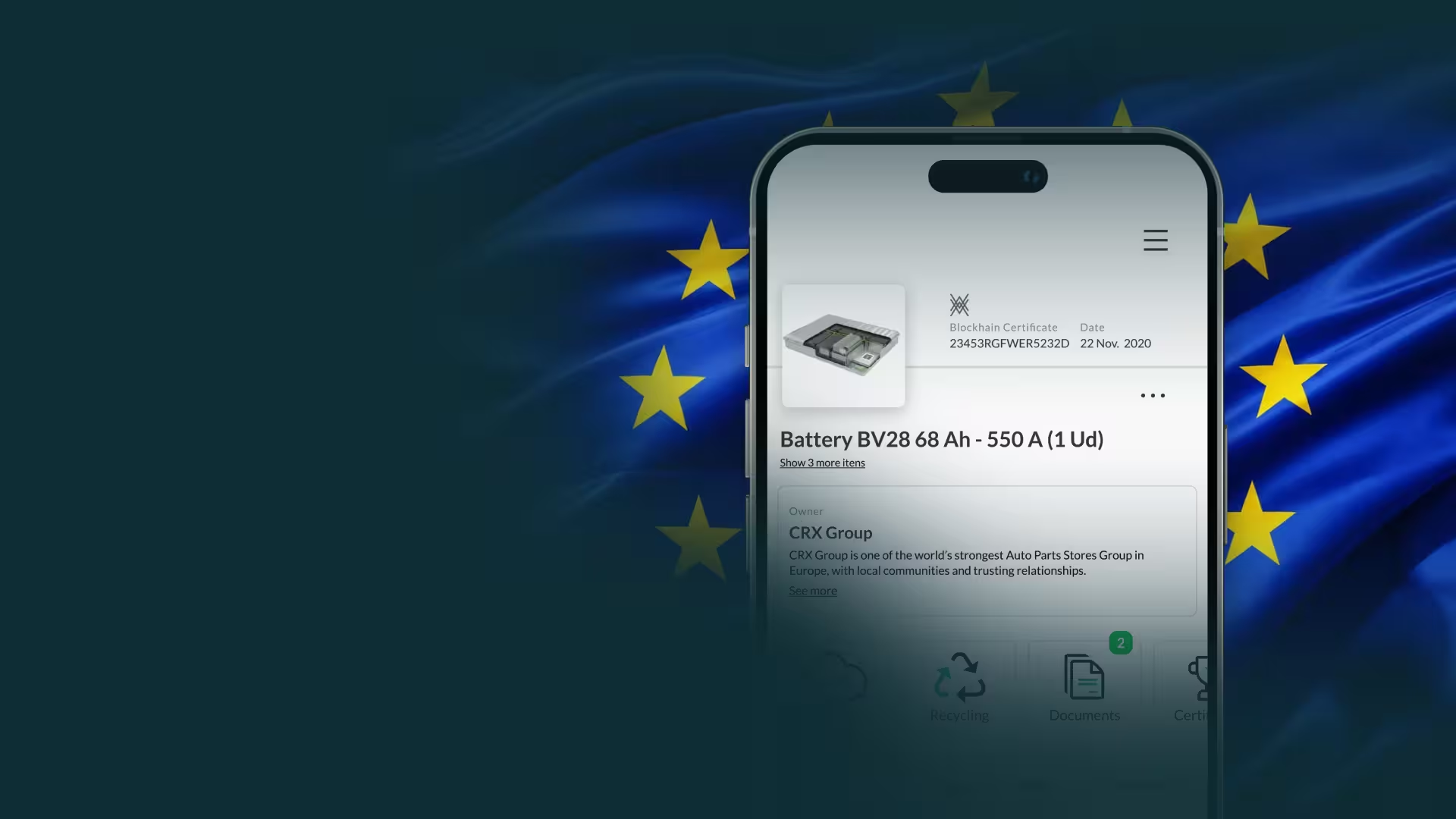
Under the EU Battery Regulation, batteries must carry a data carrier, typically a QR code, that provides direct access to battery information. However, the QR code itself is not the Battery Passport. It is simply the mechanism that allows users to access it.
The Battery Passport is the complete digital record linked to that QR code. It contains the structured information required by the regulation, including technical specifications, carbon footprint data, material composition, supply chain due diligence information, and end-of-life instructions.
This distinction is important because compliance requires more than attaching a QR code to a battery. Behind the QR code must be a functioning Battery Passport system capable of maintaining up-to-date information, supporting lifecycle updates, managing access permissions, and providing a reliable audit trail throughout the battery's lifecycle.
Does the Battery Passport apply to non-EU manufacturers and importers?
Yes. The Battery Passport requirements apply to any battery placed on the EU market, regardless of where it was manufactured.
The regulation applies to the company responsible for placing the battery on the EU market. This means that manufacturers, importers, and other responsible economic operators must ensure compliance, whether they are based inside or outside the EU.
As a result, companies based outside the EU must still comply with Battery Passport requirements if their batteries are sold in the European market.
What happens if a battery doesn't have a passport by 18 February 2027?
Without a compliant Battery Passport, the battery cannot be placed on the EU market.
From 18 February 2027, EV batteries, LMT batteries, and industrial batteries above 2 kWh will require a Battery Passport under the EU Battery Regulation. Batteries that fall within the scope of the requirement must have a compliant Battery Passport before they can be placed on the EU market.
Who can see the sensitive parts of the passport?
Not all Battery Passport data is public. Sensitive information is accessible only to authorised parties.
Battery Passports are designed with different access levels to balance transparency and confidentiality. Public information can be available through the passport, while sensitive or restricted data can be shared only with authorised stakeholders such as regulators, auditors, notified bodies, or the Commission. Further details on how each of these groups are defined and to which extent they can access the passport are expected with the implementing act on access rights.
The data owner retains control over access permissions and can determine which stakeholders can view specific information.
How does Minespider help with decentralised storage, identifiers, and access control?
Minespider combines blockchain-based verification, secure off-chain storage, persistent identifiers, and granular access controls to help companies manage Battery Passport data securely and compliantly. Using a hybrid architecture, Minespider stores cryptographic hashes on a public-permissioned blockchain to create an immutable audit trail, while the underlying Battery Passport data remains securely stored off-chain. Each passport is linked to unique, persistent identifiers and accessible through a QR code, ensuring data remains traceable, verifiable, and connected to the correct battery throughout its lifecycle.
To protect sensitive information, Minespider uses layered visibility and role-based permissions, allowing organisations to share public information broadly while restricting technical, commercial, or compliance data to authorised stakeholders. This approach helps companies meet transparency and compliance requirements while maintaining full control over their data.
Need help preparing your Battery Passport architecture? Minespider helps companies structure battery data, manage decentralised product passport records, and control stakeholder access in line with EU Battery Regulation requirements. Contact our team to discuss your 2027 readiness plan.