As Digital Product Passports move from policy discussion to real implementation, one question is becoming increasingly practical: how should a product be uniquely identified?
For companies in batteries, tyres, electronics, textiles, steel and other regulated sectors, this is no longer only an IT detail. The identifier is the bridge between the physical product and its digital record. It determines how a QR code, RFID tag, NFC tag or other data carrier leads users, authorities, customers, repairers and recyclers to the right Digital Product Passport.
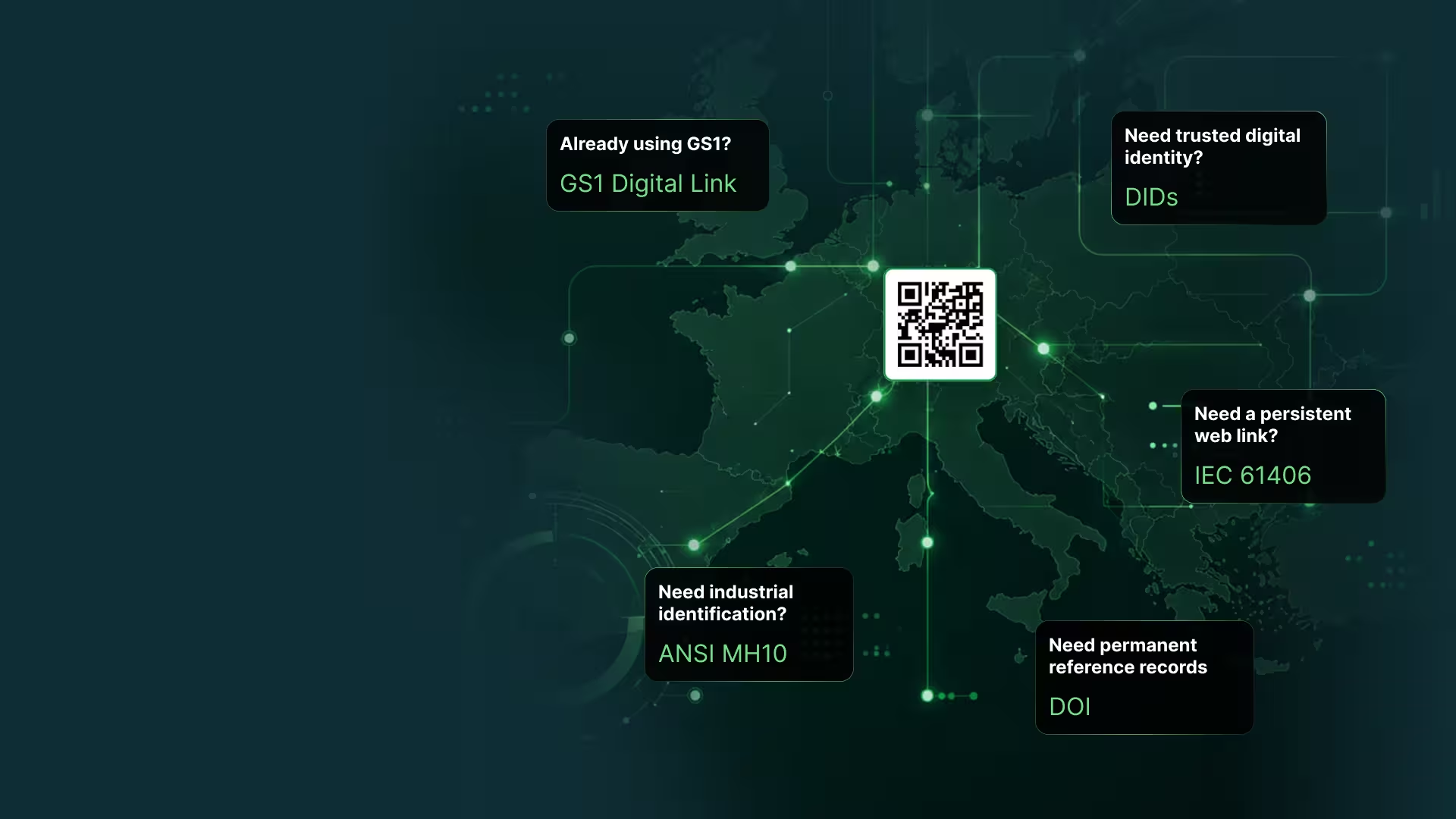
The EN 18219 standard recognises that there is no single universal route. Instead, it describes several identifier schemes that can be used depending on the product, industry, existing systems, and implementation maturity. The key is to select a method that provides uniqueness, persistence, interoperability and a reliable connection between the product and its passport.
Below are several identification approaches recognised by EN 18219 for implementing unique product identifiers in a DPP context. They should be understood as practical implementation options rather than a one-size-fits-all model.
1. Web-enabled structured path and query IDs: the standards-based web route
One of the most practical approaches recognised by EN 18219 is the web-enabled identifier. In simple terms, this means that the product identifier is structured as, or resolvable through, a web link.
This approach is particularly relevant where the identifier needs to be encoded in a QR code and scanned to open the relevant DPP. It can be implemented in two main ways: as a structured path or as a query string.
A structured path is the familiar GS1 Digital Link-style approach. For example, an individual product may be identified using:
01 / GTIN / 21 / Serial Number
Here, 01 identifies the GTIN, which usually represents the product model or trade item, while 21 identifies the serial number, which distinguishes one individual unit from another. For a battery, the GTIN may identify the battery model, while the serial number identifies the specific battery pack.
The same EN 18219 scheme can also be implemented using ASC MH10.8.2 Data Identifiers, particularly where a company already operates with industrial, logistics, material-handling or automotive identification structures outside, or alongside, the GS1 ecosystem.
This approach is attractive because it combines product identification with web access. The identifier can be read by machines, understood by systems, and resolved to the relevant DPP or related digital information.
1.1 GS1 Application Identifiers: the familiar route for many supply chains
For many companies, the GS1 route will be the most recognisable. GS1 identifiers are already widely used through GTINs, barcodes, logistics labels and product master data.
In a DPP context, the GS1 Application Identifier structure allows companies to express product identity in a standardized way. A typical item-level identifier may combine a GTIN and a serial number, allowing the product passport to refer not only to a product type, but to a specific individual item.
The implementation path is usually straightforward for companies already using GS1: confirm the GTIN, manage serial numbers, and decide whether the identifier should be represented as a GS1 Digital Link. The GS1 Digital Link may then resolve to one or more online resources, including a DPP page, technical documentation, sustainability information or after-sales content.
This makes GS1 particularly attractive for companies that need scalable identification across commercial, logistics and regulatory processes.
1.2 ANSI MH10.8.2 / ASC MH10 Data Identifiers: the industrial identification route
ANSI MH10.8.2 / ASC MH10 Data Identifiers provide another structured route for product identification, especially in industrial, manufacturing, logistics, defence and automotive environments where non-GS1 identifier structures may already be used.
The important point is that ASC MH10 is not a standalone product identifier scheme in itself. It provides the data semantics: in other words, it defines short Data Identifiers that tell a system what type of information follows. ISO/IEC 15418 recognises ASC MH10 Data Identifiers alongside GS1 Application Identifiers as accepted ways to describe the meaning of encoded identification data.
When ASC MH10 is used together with the ISO/IEC 15459 framework, it can support globally unique product or item identification. ISO/IEC 15459 provides the issuing-agency and uniqueness logic, while ASC MH10 helps structure and qualify the data elements inside the identifier.
ASC MH10 can also be relevant in an IEC 61406 Identification Link implementation (described below). In simple terms, IEC 61406 can provide the web-link connection between the physical object and its digital information, while ASC MH10 can help define the structured data elements used within that identification approach.
For DPP implementation, the ANSI MH10.8.2/ASC MH10 Data Identifier approach is particularly relevant for companies that already operate with industrial AIDC, logistics, material-handling or automotive identification structures and need a standards-based, machine-readable way to identify products, batches, assets or components outside, or alongside, the GS1 ecosystem.
2. IEC 61406 Identification Link: the direct bridge from product to digital information
The IEC 61406 Identification Link is easy to understand: it is a globally unique link attached to a physical object, usually through a QR code or NFC tag, that leads to digital information about that object. This scheme is conceptually attractive because it reflects the basic user journey companies want to enable: scan the product, open the passport.
The Identification Link should be understood as a broader concept than a specific product identifier syntax. It defines the link between the physical object and its digital information, but it does not necessarily require that all identifier semantics are visibly embedded in the URL. In some implementations, the link may be a simple persistent URL that resolves to a digital record. In other implementations, the URL may contain structured identifier elements, such as ANSI MH10.8.2 / ASC MH10 Data Identifiers.
In simple terms, IEC 61406 provides the digital bridge from the physical object to online information, while it can be complemented with structured semantics of the identifier carried by that bridge.
The Identification Link approach may therefore be suitable when a company wants a stable URL-based connection to the DPP, with flexibility over whether the URL is semantically structured or simply resolves to the correct digital record. It can be especially useful for industrial products, machinery, batteries, components and assets where a digital nameplate or passport needs to remain accessible over time.
The main implementation question is governance: who controls the link, how long it will remain active, how uniqueness is ensured, and how the link is connected to the formal product identifier. These points should be documented carefully, especially where the DPP is hosted by a service provider rather than directly by the manufacturer or economic operator.
3. Decentralized Identifiers: the trust and verification route
Decentralized Identifiers, or DIDs, are designed for digital identity without depending on a single central registry. In a product passport context, a DID could be used to identify a product, organization, facility, certificate or digital claim in a way that supports cryptographic verification.
This approach is more advanced, but it becomes interesting where the DPP is not only a web page, but part of a trust infrastructure. For example, a battery passport could contain verifiable credentials for recycled content, carbon footprint, safety testing, due diligence declarations or repair events.
The implementation path is more complex than GS1 or a simple URL. It requires choices about DID methods, keys, credential issuance, verification, governance and interoperability. For companies with high assurance requirements, however, DIDs may become important as DPP ecosystems mature.
4. Identification for products and product groups: the RFID and 2D-symbol route
EN 18219 also recognises a specific scheme for identification of products and product groups, particularly where identifiers are encoded in RFID tags or 2D symbols such as QR codes or Data Matrix codes.
This route is especially relevant where the data carrier is not just a simple web link, but part of a wider automatic identification and data capture environment. For example, an RFID tag may be used in logistics, warehouse operations, production tracking, return systems or recycling processes. A 2D symbol may also carry structured data that can be read by scanners and systems, not only by smartphones.
For DPP implementation, this approach can be useful where companies need product or batch identification to work in operational environments, including offline or semi-automated processes. It is particularly relevant for companies already using RFID, industrial labels, 2D symbols or supply-chain scanning infrastructure.
This scheme should not be confused with the DPP platform URL itself. The data carrier may point to the DPP, but the formal product or group identifier still needs to follow the applicable identification rules.
5. DOI-based identification: the persistent record route
The Digital Object Identifier, or DOI, is widely known from scientific publishing, but its principle is broader: it provides persistent identification of an object and connects it to metadata and resolution services.
In DPP terms, DOI-based identification could be useful where long-term persistence, citation, metadata governance and stable access are especially important. It may be less common for everyday product labelling, but it could be relevant for reference datasets, technical documentation, material records, research-linked products or regulated information objects connected to the passport.
The DOI route is therefore not usually the first choice for mass product marking, but it can be valuable where persistence and metadata governance are central.
Choosing the right path
For most battery and product-passport implementations, the decision should not start with the QR code. The QR code is only the AIDC carrier. The more important question is which identifier scheme will govern the formal product identity behind the code, and how that identifier will resolve to the relevant DPP record.
If the company already uses GS1 identifiers such as GTINs, the GS1 Application Identifier / GS1 Digital Link approach is often the most practical route. In this case, the product identifier can be structured with elements such as 01/<GTIN>/21/<SerialNumber> and resolved to the DPP through a GS1-hosted or self-hosted resolver.
If the company operates with established industrial AIDC, logistics, material-handling or automotive identification structures, the ANSI MH10.8.2 / ASC MH10 Data Identifier approach may be relevant. This route can support standards-based, machine-readable identification outside, or alongside, the GS1 ecosystem, particularly when used with ISO/IEC 15459 issuing-agency logic and ISO/IEC 15418 data semantics.
If the main requirement is a stable connection from a physical object to digital information, EN IEC 61406-1 Identification Link may offer a broader and flexible implementation path. The Identification Link can be a simple persistent URL without visibly embedded semantics, or it can carry structured identifier elements as ANSI MH10.8.2/ASC MH10 Data Identifiers for example.
If the implementation relies heavily on RFID, Data Matrix codes, QR codes, logistics scanning or other operational AIDC environments, the EN 18219 scheme for product and product group identification should also be considered.
If the DPP must support cryptographic trust, verifiable credentials and decentralized identity, DIDs deserve attention, especially where product claims, certificates or lifecycle events need to be independently verifiable.
If long-term persistent referencing and metadata governance are the priority, DOI-based identification may be relevant, although it is generally less common for direct product marking and day-to-day supply-chain scanning.
Final thought
Unique identifiers are not just technical strings. They are governance decisions. They define who assigns the product identity, who controls the namespace, how the passport is accessed, and how long the digital connection remains reliable.
EN 18219 gives companies several implementation options, but the same core questions remain: What object is being identified - model, batch or individual item? Which scheme governs the identifier? Who is responsible for assigning and maintaining it? How does the physical data carrier connect users to the DPP?
For companies preparing for DPP obligations, the safest approach is to separate three layers clearly: the formal product identifier, the data carrier such as QR code or RFID, and the DPP access or resolver URL. Once these roles are clear, the implementation becomes much easier to explain, validate and scale.
How Minespider approaches product identifiers
At Minespider, the identifier is where compliance actually begins. The scheme you choose decides who and how the product's identity is assigned, who controls the namespace, and how the product identifier connects to the relevant product passport and stays reachable and persistent - so we help you settle it before you build anything on top. Our Digital Product Passport and Digital Battery Passport platform runs on open, interoperable formats and keeps the product identifier, the data carrier and the passport access URL cleanly separated, but flexible to whichever EN 18219-recognised scheme you adopt so your passport stays compliant and audit-ready.
Preparing for DPP or Digital Battery Passport obligations? Book a discovery call.