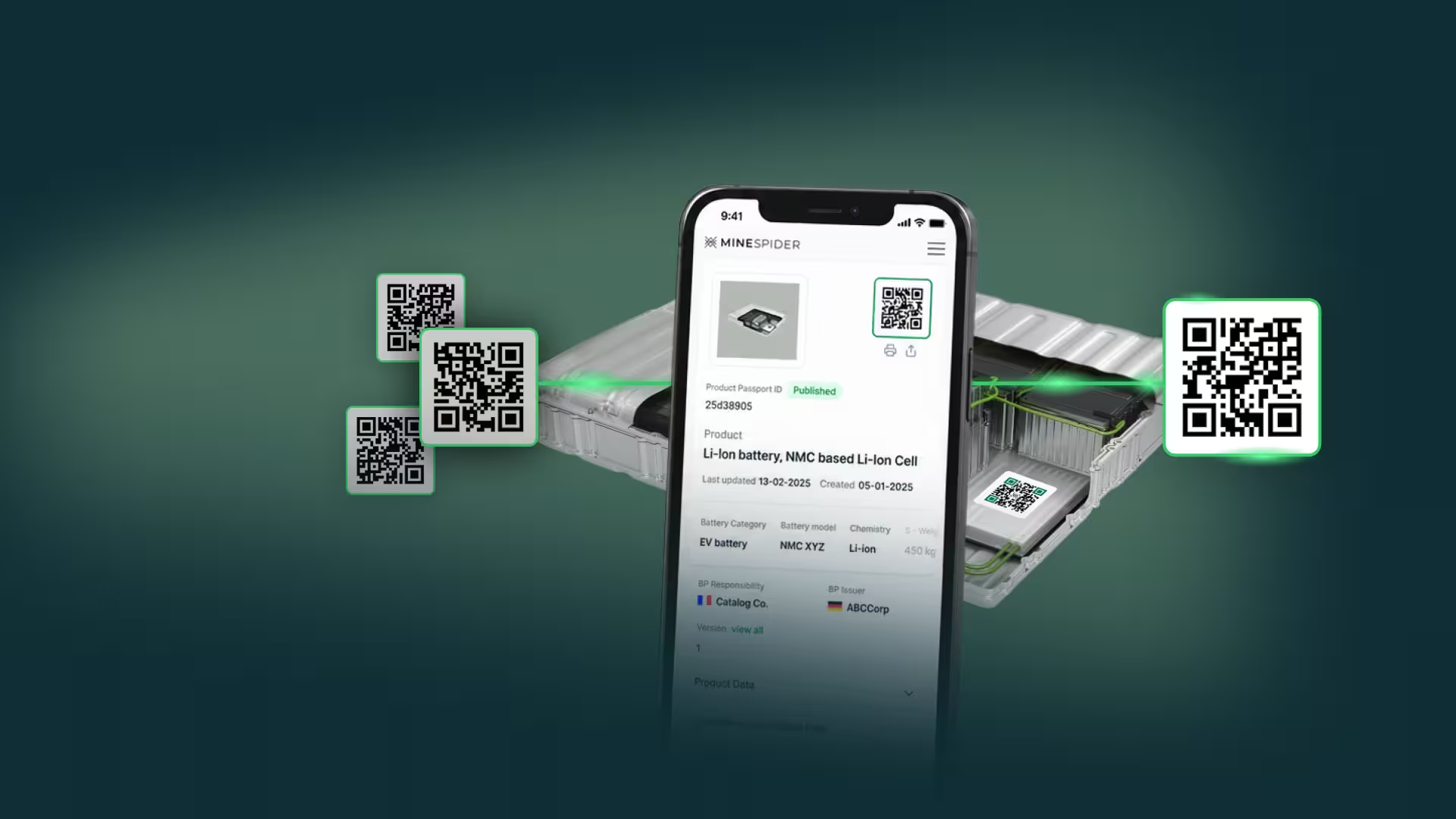
On the 19th October 2026, the European Commission published a draft implementing regulation on access rights to the Digital Battery Passport under the EU Battery Regulation (Regulation (EU) 2023/1542). Prepared under Article 77(9) of the Regulation, the draft names who counts as a person with a "legitimate interest" in restricted battery passport information, which sections of the passport each of them can access, and what they may do with the data once they have it. The draft is open for public feedback until the 16th of November 2026 and has not yet been adopted.
Article 77(9) set the 18th of August 2026 as the date for the Commission to adopt this implementing act, so the draft comes after that deadline. It is a separate date from the 18th of February 2027, when Digital Battery Passports become required for light means of transport (LMT) batteries, industrial batteries with a capacity above 2 kWh and electric vehicle (EV) batteries placed on the market or put into service. That leaves less than four months between this draft and the passport obligation itself.
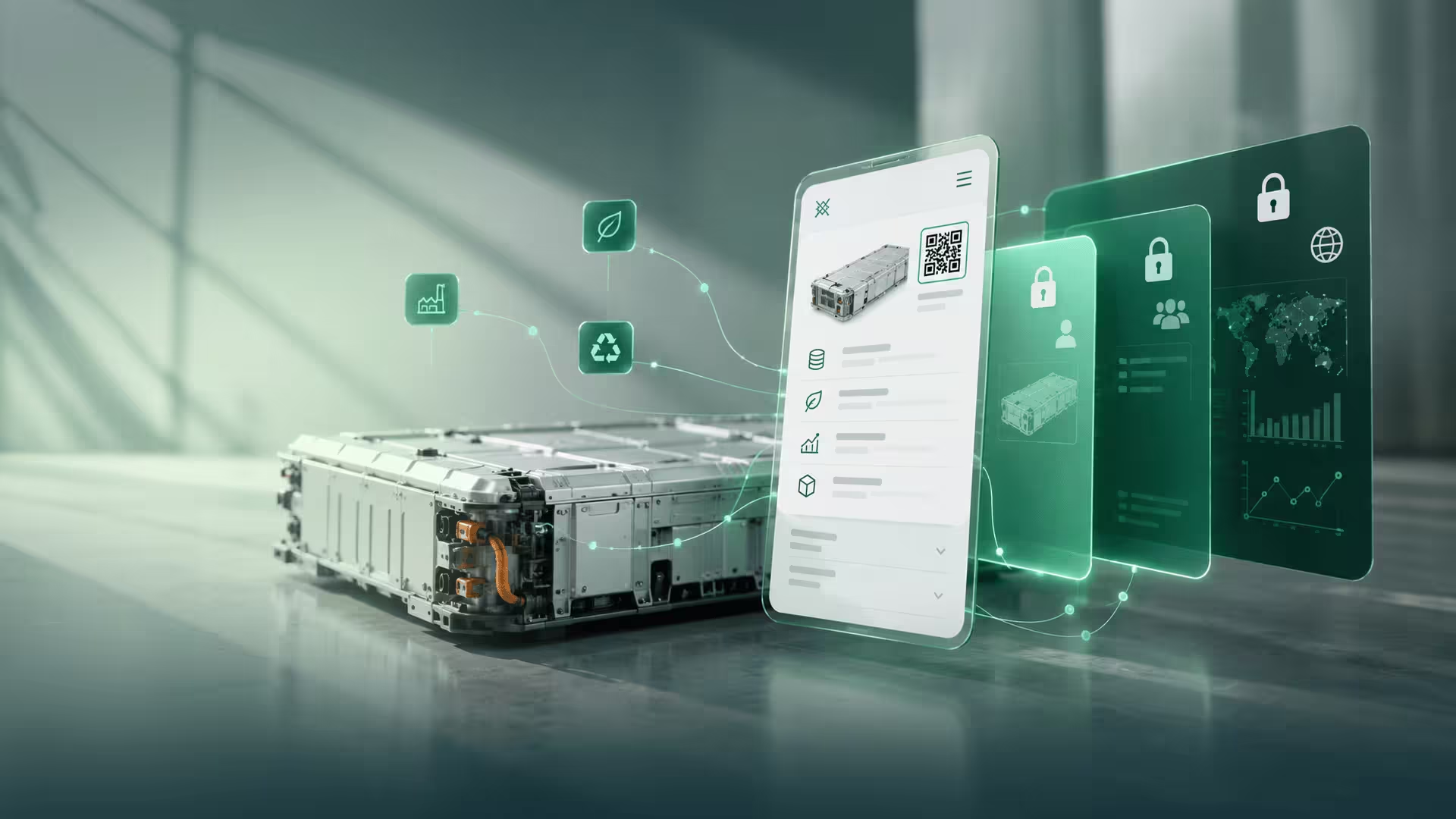
We believe it’s also a good moment to clear up a common misconception. A battery passport is not a single public page that opens when you scan the QR code on a battery. It is a layered data record, and what you see depends on who you are and why you are looking. This means that a consumer, a recycler planning how to take a pack apart and a buyer checking the health of a second-hand battery can all scan the same code, and each of them is entitled to a different part of the passport.
"Who will see this?" is one of the first questions we hear in almost every Digital Battery Passport implementation, so we have mapped the whole draft into a single view and answered the questions people ask us most. As a leading Digital Battery Passport provider, Minespider will also be sharing feedback on the draft with the Commission before the consultation closes.
The short version
- These are proposed rules: the draft has not been adopted yet, so they are not final law.
- Battery model essentials, such as chemistry, carbon footprint, recycled content, capacity and expected lifetime, are public - anyone can see them.
- Detailed composition, spare parts, disassembly and safety information goes to named repair, second-life and end-of-life companies, with a different list for each section. The battery purchaser can also see spare parts and safety information.
- Data about the individual battery, such as its state of health and usage history, goes to the purchaser and anyone acting on their behalf.
- Compliance test reports will stay with notified bodies, market surveillance authorities and the European Commission.
- Restricted data comes with certain purpose limits and sharing rules. Safety measures are the exception: they are still restricted to named groups, but anyone in those groups can use, share and publish them without limits.
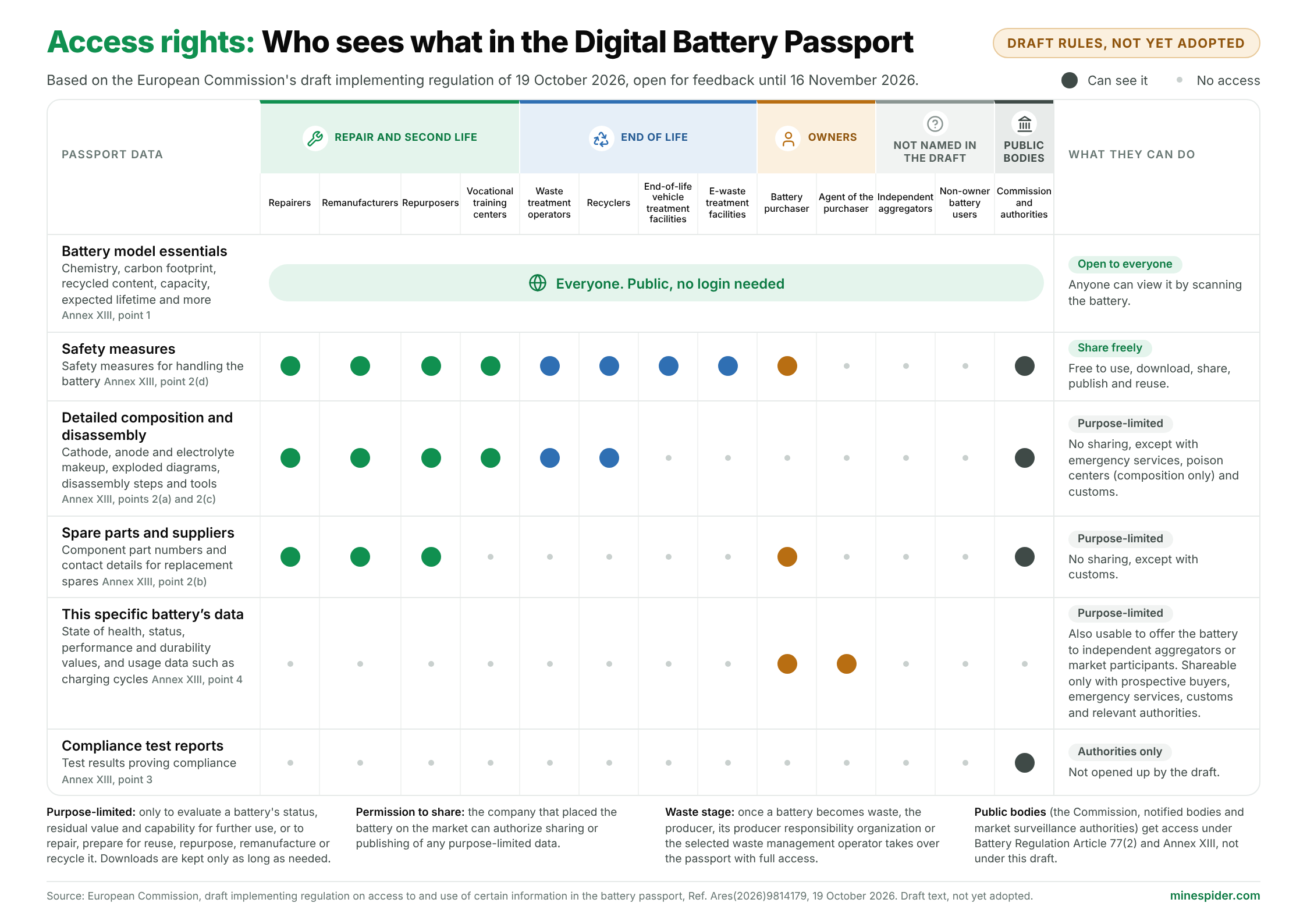
Who sees what in the Digital Battery Passport, based on the Commission draft of 19 October 2026.
Public bodies means notified bodies, market surveillance authorities and the European Commission, whose access comes from Article 77(2) of the Battery Regulation. Draft rules, not yet adopted.
Who can see the information in a battery passport?
The EU Battery Regulation (Regulation (EU) 2023/1542) sets out three audiences in Article 77(2), and Annex XIII lists the information that belongs to each:
- Everyone: the battery model information in Annex XIII, point 1, is publicly accessible.
- Persons with a legitimate interest: the detailed model information in point 2 and the information about the individual battery in point 4.
- Notified bodies, market surveillance authorities and the European Commission: the information in point 2 and the compliance test reports in point 3.
The Regulation only describes "legitimate interest" in broad terms, mentioning repairers, remanufacturers, second-life operators and recyclers for battery model information, and purchasers and parties acting on their behalf for individual battery information. The new draft is the piece that turns that into a specific list of companies, with each matched to specific sections of the passport.
Which information is public, and which is restricted?
Public (Annex XIII, point 1). Anyone can see the battery model information listed in Annex XIII, point 1, including the general information required under Annex VI, Part A, its chemistry, hazardous substances (other than mercury, cadmium and lead) and critical raw materials, carbon footprint, responsible sourcing information, recycled and renewable content, rated capacity, voltage and power capability, expected lifetime, warranty period, round-trip efficiency, internal resistance, the EU declaration of conformity and information on preventing and managing waste batteries.
Note the difference between the two kinds of composition data. The public layer shows the battery's chemistry, hazardous substances and critical raw materials (point 1(b)), while the detailed composition, down to the materials in the cathode, anode and electrolyte (point 2(a)), is restricted.
Restricted (Annex XIII, points 2, 3 and 4). Everything else sits behind access rights:
- Detailed composition, including the materials used in the cathode, anode and electrolyte (point 2(a))
- Component part numbers and contact details for replacement spares (point 2(b))
- Dismantling information, such as exploded diagrams, disassembly sequences, fastenings, tools, damage warnings and the number and layout of cells (point 2(c))
- Safety measures (point 2(d))
- Test report results proving compliance (point 3)
- Data about the individual battery: performance and durability values, state of health, status (original, repurposed, reused, remanufactured or waste) and usage data such as the number of charging and discharging cycles, negative events such as accidents, temperature and state of charge (point 4)
Who counts as having a legitimate interest?
For every section open to persons with a legitimate interest, the draft gives its own list of who qualifies:
- Detailed composition and dismantling information (points 2(a) and 2(c)): repairers, remanufacturers, repurposers, waste management operators carrying out treatment, recyclers, and vocational training centers for battery repair, repurposing or remanufacturing.
- Spare parts information (point 2(b)): repairers, remanufacturers, repurposers and the purchaser of the battery.
- Safety measures (point 2(d)): everyone in the two groups above, plus treatment facilities for end-of-life vehicles and for waste electrical and electronic equipment.
- Individual battery data (point 4): the purchaser of the battery and any third party acting on their behalf.
Two choices stand out to us. Vocational training centers are named explicitly, alongside repurposers, because the Commission sees both as key second-life operators. And purchasers get spare parts information, which the Commission links to simple in-house repairs. Both point in the same direction: the passport is meant to keep batteries in use for longer.
What can they do with the data once they have it?
Access comes with conditions, and this is where the draft protects information that could be commercially sensitive for the company that placed the battery on the market.
- Purpose limits: composition, spare parts, dismantling and individual battery data can only be used to evaluate a battery's status, residual value and capability for further use, or for repair, preparation for reuse, preparation for repurposing, repurposing, remanufacturing or recycling, including choosing between those options. Purchasers can also use the individual battery data to make the battery available to independent aggregators or market participants.
- Downloads: people with purpose-limited access may download and use the information, but must not keep downloaded information longer than necessary for those purposes.
- Sharing: the default is no sharing and no publishing, with a short list of exceptions. Repairers, remanufacturers, repurposers, treatment operators, recyclers and training centers may share composition and dismantling data with emergency services, and composition data with poison centers. Purchasers and those acting for them may share individual battery data with emergency services, prospective buyers of the battery, market surveillance authorities and the authorities responsible for the waste battery management obligations in Chapter VIII of the Battery Regulation. Everyone with access to composition, spare parts, dismantling or individual battery data may share it with customs authorities.
- Permission: the company that placed the battery on the market can authorize wider sharing or publishing of any of this data.
- Safety measures: access is still limited to the groups named above, but once they have it, they can use, download, share, publish and reuse the information without restriction, because the Commission considers this information essential and not commercially sensitive.
For battery makers, this is a balanced outcome. The know-how that repairers and recyclers need reaches them, while commercially sensitive information stays protected.
Do regulators and notified bodies have different access rights?
Yes regulators and notified bodies have different access rights that come directly from the Battery Regulation rather than from this draft. Notified bodies, market surveillance authorities and the European Commission can see the restricted model information in point 2, and they are the only ones who can see the compliance test reports in point 3. Data about the individual battery in point 4 is reserved for people with a legitimate interest, although the draft allows purchasers to share it with market surveillance authorities and the authorities responsible for waste battery management.
Does scanning the QR code show the whole passport?
No, scanning the QR code does not show all the Digital Battery Passport data. The QR code on the battery is the way into the passport, but scanning it does not unlock everything. The public layer is open to anyone, while restricted sections are only for people with the right to see them. This is why we describe a battery passport as an access-controlled data record rather than a document: the same code serves a curious customer, a repair shop and a recycler, and each of them should land on the information they are entitled to.
What happens when a battery becomes waste?
Under Article 77(7) of the Battery Regulation, when a battery's status changes to waste, responsibility for keeping the passport accurate, complete and up to date moves to the producer, its producer responsibility organization where one is appointed, or the selected waste management operator. As the draft explains, they can modify the passport and access its full content, so they do not need to be listed as persons with a legitimate interest. Treatment operators and recyclers who handle the battery without holding that responsibility get access through the draft instead.
What the draft leaves open
The draft answers the "who" and the "what" clearly. A few questions that come up in our client conversations are still open:
- How legitimate interest is checked. The draft names who qualifies, but not how a repairer or recycler proves it, or how a passport provider confirms it before opening a restricted section.
- Battery users who are not the purchaser. Fleet operators and leasing customers are not named as a group of their own. As we read the draft, their route to individual battery data would be acting on behalf of the purchaser.
- Independent aggregators. The Battery Regulation names making a battery available to independent energy aggregators or energy market participants as a reason for purchasers to access individual battery data, and the draft repeats that purpose. Aggregators do not get access in their own right, though, and they are not among the recipients listed in the draft's sharing rules, so how purchasers can pass data to them is not yet clear.
- Other parties in the battery's life. Insurers, financiers and marketplaces are not named, either among those with access or among the recipients purchasers may share data with. Wider sharing would need permission from the company that placed the battery on the market.
These are exactly the kinds of points worth raising during the feedback period.
How should companies decide access for each data field?
Start with the regulation, not the screen. In the passports we have built so far, these steps have made access decisions much simpler:
- Map every data field to its Annex XIII point. The draft attaches each audience to a point, so once a field is mapped, most of its access question is already answered.
- Make the public layer complete and current. It is what customers, distributors and journalists see first, and a well-kept public passport is a strong first impression for your product.
- Treat restricted data as something you share on your terms. The company that placed the battery on the market can authorize wider sharing, for example with a recycling partner or a service network. That is a commercial lever, not only a compliance setting.
- Plan for updates. Performance values, state of health and status change over a battery's life, so the passport has to keep up. That is why most of our clients connect their passports to their ERP, PLM or MES systems instead of updating them by hand.
- Send your feedback. If one of the open points affects your business, the Have Your Say page accepts comments until 16 November 2026. We will be sharing ours there too.
Frequently asked questions
Is the EU battery passport access rights regulation final? No, the EU battery passport access rights regulation is not final. The European Commission published it as a draft implementing act on 19 October 2026, with feedback open until 16 November 2026. Its access rights are proposed rules until the Commission adopts the final text.
When do battery passport requirements apply? Digital Battery Passport requirements apply from 18 February 2027, for light means of transport batteries, industrial batteries with a capacity above 2 kWh and electric vehicle batteries placed on the market or put into service.
Can battery recyclers access detailed composition and dismantling data? Yes, under the draft battery recyclers can access detailed composition and dismantling data. Recyclers are among the persons with a legitimate interest in detailed composition (point 2(a)), dismantling information (point 2(c)) and safety measures (point 2(d)), and may use the first two only for the purposes the draft lists.
Can a battery purchaser share battery passport data with a prospective buyer? Yes, a battery purchaser can share battery passport data with a prospective buyer but only the individual battery data in point 4, such as state of health and status. The draft does not extend this to the other restricted sections.
Keeping this guide up to date
We will update this guide as the draft moves toward adoption and the final text is published. If you are working out how access rights apply to your own battery passports, write to us at hello@minespider.com, or take a look at our battery passport pricing.